
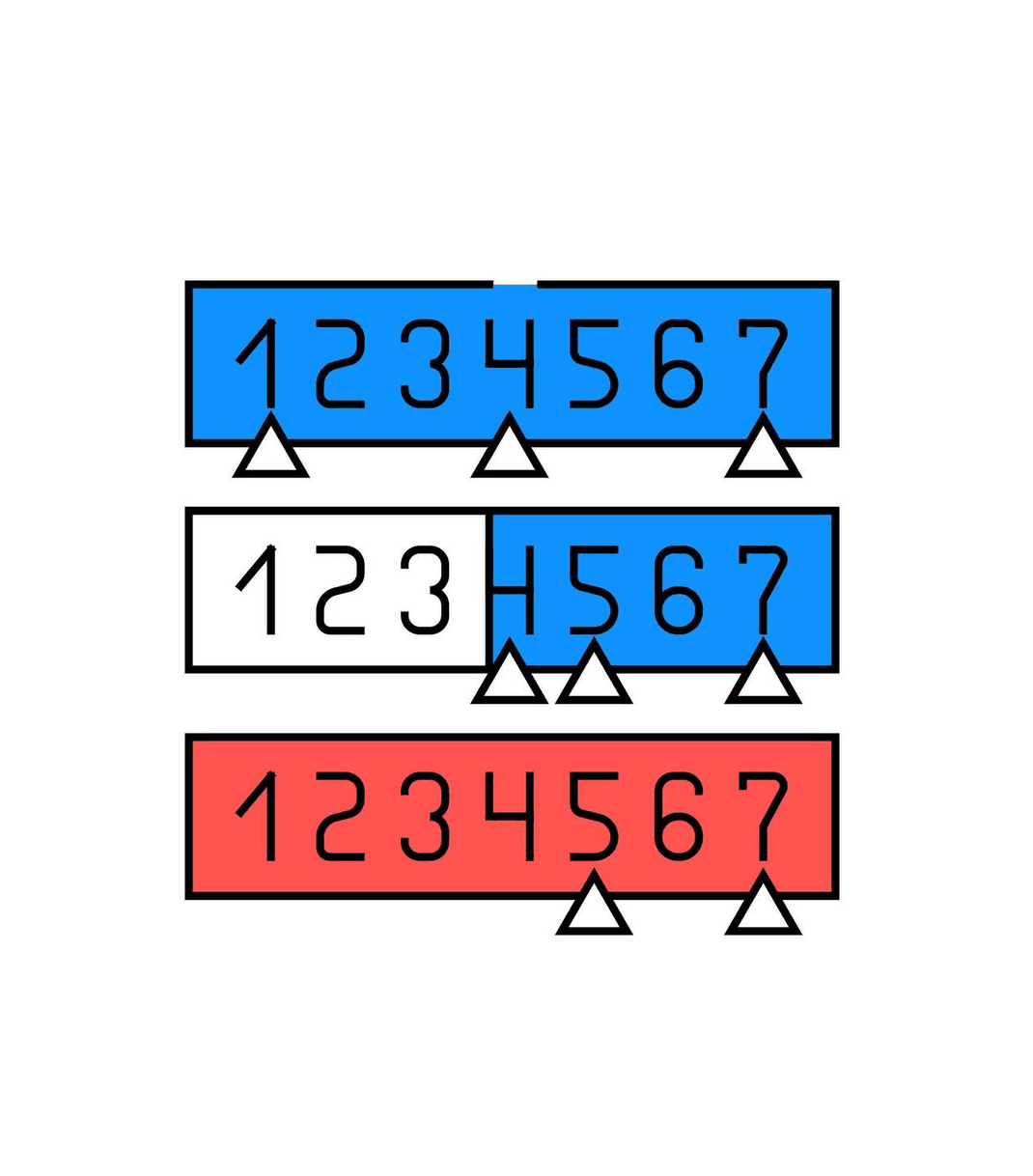
LeetCode: Two Pointers II Binary Search
If you don't reduce the search space and include mid, the loop may never terminate
- Insight on Pointer Updates
- Limitation with duplicates
- Binary Search Application: Target Binary Search
- Binary Search Application: Multiple Layers Binary Search
- Binary Search Application: Optimization Search Min Max Binary Search
- Binary Search Application: Condition Adapted Binary Search
- Binary Search Application: Upper Ceiling or Lower Floor Trick Based on Target Binary Search
981. Time Based Key Value Store ::2:: - Medium
- Intro
- Abstraction
- Pseudocode
- Solution 1: Reverse Linear Scan - Binary Search/Condition Adapted Binary Search
- Solution 2: Upper Ceiling to Find First Invalid TimeStamp - Binary Search/Upper Ceiling or Lower Floor Trick Based on Target Binary Search
- Solution 3: Floor Search Tracking Largest Valid Index With Right Pointer - Binary Search/Upper Ceiling or Lower Floor Trick Based on Target Binary Search
Binary Search Intro:
Leetcode problems with elegant solutions using binary search.
What is Binary Search
Binary Search is a divide and conquer algorithm for searching sorted lists or ranges effectively.
It works by creating a middle value, comparing middle value to the target or evaluating a condition, and halving the search space based on that comparison.
Why Use Binary Search
Binary search reduces the search space by half on each iteration.
| Technique | Time Complexity | Space Complexity |
|---|---|---|
| Linear Search | O(n) | O(1) |
| Binary Search (Recursive) | O(log n) | O(log n) |
| Binary Search (Iterative) | O(log n) | O(1) |
Target Binary Search
Used to search for a specific value or index.
    def binary_search(nums, target):
        left, right = 0, len(nums) - 1

        # Note 1:
        # Target Binary Search: uses '<='
        while left <= right:
            mid = (left + right) // 2

            # Note 2:
            # 3 parts during iteration
            # target check, remove left half, remove right half
            if nums[mid] == target:
                return mid
            elif nums[mid] < target:
                left = mid + 1
            else:
                right = mid - 1

        # Note 3:
        # Exit: left > right triggers ends
        # Return value if not found
        return -1
Monotonic Optimization Min/Max Binary Search
Used to find the smallest or largest value that satisfies a condition.
- Find the min element greater than or equal to the target:
In ceiling search, the goal is to locate the minimal number in a sorted
    def find_min_valid_value():
        left, right = 0, N-1

        # Note 1:
        # Optimization Binary Search: uses '<'
        while left < right:
            mid = (left + right) // 2

            # Note 2:
            # Check if condition is satisfied
            # If so, include mid with left or right half
            if condition(mid):
                # or left = mid, depending on which half we are checking
                right = mid
            else:
                # or right = mid + 1, depending on which half we are removing
                left = mid + 1

        # Note: 3
        # Exit: left == right, triggers the exit
        # we have found the optimized solution

        # or right
        return left
Optimization Ceiling and Floor Style Binary Search
Variant of Optimization Binary Search:
The rule is that we can search directly for ceilings, but not for floors.
You can search directly for the ceiling (smallest element >= target) with binary search because the loop naturally stops at that boundary.
    def find_ceiling(nums, target):
        left, right = 0, len(nums)

        # Loop condition: left < right
        while left < right:
            mid = (left + right) // 2

            # If mid element is less than target,
            # the ceiling must be to the right of mid (exclude mid)
            if nums[mid] < target:
                left = mid + 1
            else:
                # nums[mid] >= target, potential ceiling candidate
                # Keep mid in search space by moving right boundary to mid
                right = mid

        # At the end, left == right, points to the smallest element >= target if exists
        # If left == len(nums), no ceiling found
        if left == len(nums):
            return None
        return nums[left]
You cannot search directly for the floor (largest element < = target) with binary search
def find_floor_wrong(nums, target):
    left, right = 0, len(nums)

    # Loop condition: left < right
    while left < right:
        mid = (left + right) // 2

        # Attempt:
        # mid element <= target:
        # move left boundary up to mid (include mid)
        if nums[mid] <= target:

            # PROBLEM:
            # left might not move forward when left == mid, causing infinite loop
            left = mid

        else:
            # mid element > target:
            # move right boundary down (exclude mid)
            right = mid

    # When loop ends, left == right, but it may not point to floor directly
    # Without shifting left or checking bounds, this is unreliable
    if left == 0 and nums[left] > target:
        return None
    return nums[left]
Understanding Optimization Search: Min vs Max
In optimization style binary search, we're not finding a specific value, but rather are finding the smallest or largest values that satisfies a condition.
- Finding the Minimum Valid Value
    if condition(mid):
        right = mid        # mid might be the answer, keep it
    else:
left = mid + 1 # mid is invalid, discard it- Finding the Maximum Valid Value
    if condition(mid):
        left = mid         # mid might be the answer, keep it
    else:
        right = mid - 1    # mid is invalid, discard it`
Why Binary Search Can Find < or > but Not < or > equal to
Binary Search splits the space at mid and decides whether to include or exclude it.
This means it works best with strict boundaries.
Its easy to shrink towards a point where the transition happens on < or >.
However, it struggles with ambiguous boundaries like < and > or equal to. As you don't know which direction to move in.
Ex: first element < or equal to target
# When:
    arr[mid] == target

# Should you go left or right?
# If you go right, you might miss an earlier match
# If you go left, you might go too far and miss it entirely
# If you don't reduce the search space and include mid, the loop may never terminate
So binary search prefers to work with < for upper bound, > for lower bound. And shift answer manually to get < and > or equal to.
Insight on Pointer Updates
A basic but easily overlooked principle in binary search is that the search space must shrink with every iteration.
This ensures the algorithm makes progress and terminates.
In target binary search:
We are looking for a specific index or value. After comparing mid, we either return mid as we have found the target, or search the left or right subspace while excluding mid as mid has already been checked.
In target binary search, we might hit the target before the pointers trigger termination
In optimization binary search:
We are looking for a min/max valid value, not just looking for a specific value. In this case after comparing mid, search the left or right subspace and include mid as mid could be the potential solution, until our pointers hit each other and we have found our optimal solution.
In optimization binary search, the trigger will be that the pointers will equal each other every time, returning the optimal solution.
Limitation with duplicates
In most standard binary search problems, duplicates do not interfere with correctness or efficiency as long as:
- The array is fully sorted
- We're doing a target lookup or numeric optimization
- No structural transformations like rotation or flattening is applied that would affect the sorted order
Some problems depend on structure or ordering of elements (e.g., rotated arrays). In these cases, duplicates introduce ambiguity that binary search cannot resolve cleanly.
Ex: without duplicates
nums = [4, 5, 6, 7, 0, 1, 2]

def find_min_no_duplicates(nums):
    left, right = 0, len(nums) - 1

    while left < right:
        mid = (left + right) // 2

        if nums[mid] > nums[right]:
            # Min must be in the right half (excluding mid)
            left = mid + 1
        else:
            # Min is at mid or in the left half
            right = mid

    return nums[left]
Ex: with duplicates
nums = [2, 2, 2, 0, 1, 2]

def find_min_with_duplicates(nums):
    left, right = 0, len(nums) - 1

    while left < right:
        mid = (left + right) // 2

        if nums[mid] > nums[right]:
            left = mid + 1
        elif nums[mid] < nums[right]:
            right = mid
        else:
            # nums[mid] == nums[right], can't determine side, shrink range
            right -= 1

    return nums[left]
Binary Search Application: Target Binary Search
Using Binary Search to locate the position of a target element in a sorted list by repeatedly dividing the search interval in half.
Ex: Searching for a target number in a sorted array.
    def binarySearch(nums, target):
    left, right = 0, len(nums) - 1

    while left <= right:
        mid = (left + right) // 2

        if nums[mid] == target:
            return mid  # Target found
        elif nums[mid] < target:
            left = mid + 1  # Search right half
        else:
            right = mid - 1  # Search left half

    return -1  # Target not found
Binary Search Application: Multiple Layers Binary Search
Applying binary search in multiple stages or layers, typically to first narrow down a substructure (i.e., row, segment, or time range), and then again within that substructure
This approach is useful when data is structured in nested sorted layers.
Ex: Searching for a target in a sorted 2D matrix
    def searchMatrix(matrix: List[List[int]], target: int) -> bool:
        if not matrix or not matrix[0]:
            return False

        rows, cols = len(matrix), len(matrix[0])

        # First layer: Binary search over rows to find candidate row
        top, bottom = 0, rows - 1
        while top <= bottom:
            mid_row = (top + bottom) // 2
            if matrix[mid_row][0] <= target <= matrix[mid_row][-1]:
                break
            elif matrix[mid_row][0] > target:
                bottom = mid_row - 1
            else:
                top = mid_row + 1
        else:
            return False  # Target is outside all row ranges

        # Second layer: Binary search within the found row
        row = mid_row
        left, right = 0, cols - 1
        while left <= right:
            mid_col = (left + right) // 2
            if matrix[row][mid_col] == target:
                return True
            elif matrix[row][mid_col] < target:
                left = mid_col + 1
            else:
                right = mid_col - 1

        return False
Binary Search Application: Optimization Search Min Max Binary Search
Using binary search to find the smallest or largest valid value that satisfies a given constraint (e.g., minimum speed, minimum time, maximum capacity)
Searches over a numeric range, not for a target, and typically uses while left < right (left == right, as a trigger) to fin the min or max boundary.
Ex: Find the minimum eating speed to finish all bananas within h hours
    def minEatingSpeed(piles: List[int], h: int) -> int:
        def hours_needed(speed):
            return sum((pile + speed - 1) // speed for pile in piles)  # ceil

        left, right = 1, max(piles)

        # Optimization Search
        while left < right:
            mid = (left + right) // 2

            # Try slower (minimization)
            if hours_needed(mid) <= h:
                right = mid

            # Need faster
            else:
                left = mid + 1

        # Note:
        # there is no case where left > right breaks the loop,
        # because the condition is < and not <=,
        # so trigger will always be:
        # left == right

        # Smallest k that works
        return left
Binary Search Application: Condition Adapted Binary Search
Adapting search conditions of binary search to account for special problem parameters or constraints (e.g., rotated array, duplicates, bounded search).
Covers problems where binary search is applied, but the standard algorithm is modified.
Ex: Finding the minimum element in a rotated sorted array
    def findMin(nums: List[int]) -> int:
        left, right = 0, len(nums) - 1

        # If array is not rotated (fully sorted ascending)
        if nums[left] < nums[right]:
            return nums[left]

        # Modified binary search with parameter-based decision
        while left < right:
            mid = (left + right) // 2

            # Decision based on comparing mid and right elements
            if nums[mid] > nums[right]:
                left = mid + 1
            else:
                right = mid

        # left == right points to minimum element
        return nums[left]
Binary Search Application: Upper Ceiling or Lower Floor Trick Based on Target Binary Search
Binary search cannot directly find the largest element less than or equal to a target (or similarly find the smallest elements greater than or equal to a target) in one step.
Instead we search for the first element greater than the target and then simply shift one position left to get the largest element less than or equal.
Ex: Find the first element less than or equal to target
    def largest_leq_shift(nums, target):
        left, right = 0, len(nums)  # half-open interval [left, right)

        while left < right:
            mid = (left + right) // 2
            if nums[mid] <= target:
                left = mid + 1  # move right since mid less to target
            else:
                right = mid     # mid > target, shrink right side

        # left is now the index of first element > target
        # so the answer is at left - 1 (if valid)
        return nums[left - 1] if left > 0 else ""
167. Two Sum II Sorted Array ::2:: - Medium
Topics: Array, Two Pointers, Binary Search
Intro
Given a 1 indexed array of sorted integer in non decreasing order, find two numbers that add up to a target. Let these two numbers be numbers[index1] and numbers[index2] where 1 ≤ index1 < index2 ≤ numbers.length. Return the indices of the two numbers, index1 and index2, added by one as an integer array [index1, index2] of length 2. The tests are generated such that there is exactly one solution. You may not use the same element twice.
| Input List | Input Target | Output |
|---|---|---|
| [2, 7, 11, 15] | 9 | [1,2] |
| [2, 3, 4] | 6 | [1,3] |
| [-1, 0] | -1 | [1,2] |
Constraints:
Solutions can only use constant space O(1)
Abstraction
Given a sorted array, find two numbers that add up to target, and numbers cannot share indexes.
Pseudocode
oh! pseudocode hasn't been written yet, try another card! :)Solution 1: [Two Pointers] Opposite Ends Pointer Shift by BinarySearch Modification for Target [TC Opt] - Two Pointers/Opposite Ends
    def twoSumII(self, numbers: List[int], target: int) -> List[int]:

        # Set up BinarySearch Modification
        # initialize outer pointers
        # space complexity: left and right pointers constant O(1)
        left, right = 0, len(numbers) - 1

        # BinarySearch Modification
        # "<": working within subarray containing left and right
        # cannot evaluate num at left == right, breaks constraints of index1 < index2
        # Base Case: no more array remaining to search,
        # return []
        # time complexity: iterate over list of n length O(n)
        while left < right:

            # grab current sum
            currSum = numbers[left] + numbers[right]

            # Note:
            # BinarySearch Pattern (1)
            # 3 Paths: check middle target, if left path, else right path

            # check middle target: found sum
            if currSum == target:

                # convert to 1-indexed array, per test cases
                return [left + 1, right + 1]

            # eheck left path: currSum is too low
            elif currSum < target:
                left += 1

            # else right path: currSum is too high
            else:
                right -= 1

        # overall: time complexity O(n)
        # overall: space complexity O(1)
        return []
15. 3Sum ::2:: - Medium
Topics: Array, Two Pointers, Sorting, Binary Search
Intro
Given an integer array nums, return all the triplets [nums[i], nums[j], nums[k]] such that i != j, i != k, and j != k, and nums[i] + nums[j] + nums[k] == 0. Notice that the solution set must not contain duplicate triplets.
| nums | Output |
|---|---|
| [-1,0,1,2,-1,-4] | [[-1,-1,2],[-1,0,1]] |
| [0,1,1] | [] |
| [0,0,0] | [[0,0,0]] |
Constraints:
Abstraction
Given an array find all the groups of 3 integers that add up to 0, without duplicates.
Sorting vs non-sorting is the first distinction which will lead to different solutions.
We can:
- Sort by increasing value
- Sort by parity
Both of these give us different assumptions we can use to our advantage as we traverse the array. Let see:
Pseudocode
oh! pseudocode hasn't been written yet, try another card! :)Solution 1: [Sorting] Two Sum Mimic By Per Element Opposite Ends Pointer Shift By BinarySearch Modification For 0 [TC Opt] - Two Pointers/K Pointer Variants
    def threeSum(self, nums: List[int]) -> List[List[int]]:

        # Note:
        # Two sum: finding two numbers whose sum equals a target is simple
        # with hashmaps or two pointer solutions being efficient
        # 3Sum: adds complexity with a third variable,
        # but adding constraints turns 3Sum into a two sum
        # and allows the use of hashmap or two pointer solutions again

        # set ensures no duplicate triplets
        # sc: relative to input O(n)
        results = set()
        n = len(nums)

        # tc: python (2.3-3.10) TimSort, Python (3.11+) PowerSort Worst/Avg: O(n log n), Best: O(n)
        # sc: sorts in place, no extra memory O(1)
        nums.sort()

        # tc: iterate over list O(n)
        for i in range(n - 2):

            # Skip Duplicates:
            # i should only "BinarySearch" through any number once
            if 0 < i and nums[i] == nums[i - 1]:
                continue

            # Require At Least 1 Negative Number:
            # i is only allowed negative number for the sum of (i, j, k)
            if 0 < nums[i]:
                break

            # Note:
            # BinarySearch Pattern (1)
            # 3 Paths: check middle target, if left path, else right path

            # shift left boundary
            # reset right boundary to rightmost
            left, right = i + 1, n - 1

            # BinarySearch Modification (1)
            # cannot evaluate num at left == right given constraint i != j, i != k, j != k
            # thus, change to left < right instead of left <= right

            # Base case:
            # no more array remaining,
            # numbers[i] complement not found,
            # go to next i iteration

            # tc: BinarySearch on n elements O(log n), for n iterations O(n), (n log n)
            while left < right:

                # grab current sum (i, j, k)
                currSum = nums[i] + nums[left] + nums[right]

                # Target Found:
                # found a new combination of (i, j, k)
                if currSum == 0:

                    # add triplet to result set
                    results.add((nums[i], nums[left], nums[right]))

                    # Skip (j, k) from (i, j, k):
                    # given our frozen negative i,
                    # only j and k can combine to 0,
                    # no other values can combine with either (i, j, q) or (i, p, k)
                    # thus we must iterate both j and k
                    left += 1
                    right -= 1

                    # Skip Duplicates:
                    # skip any duplicates of either j or k, since we need new numbers
                    while left < right and nums[left] == nums[left - 1]:
                        left += 1
                    while left < right and nums[right] == nums[right + 1]:
                        right -= 1

                # currSum is too low:
                # need a higher lower j number
                elif currSum < 0:
                    left += 1

                # currSum is too high:
                # need a lower upper k number
                else:
                    right -= 1

        # Covert set of tuple triplets into list
        # to avoid checking for duplicates

        # overall: tc O(n^2)
        # overall: sc O(n)
        return list(results)
Solution 2: [No Sorting] Grouping By Parity 4 Triplet Combinations [Time Limit Exceeded] - Two Pointers/Algorithm
    def threeSum(self, nums: List[int]) -> List[List[int]]:

        # Note:
        # Two sum: finding two numbers whose sum equals a target is simple
        # with hashmaps or two pointer approaches
        # 3Sum: adds complexity with a third variable.
        # Grouping techniques aim to narrow and organize the solution space
        # reducing redundant checks while finding valid triplets

        # group by parity: positive, negative, and zero sets
        # sc: relative to input O(n)
        p, n, z = [], [], []

        # set ensures no duplicate triplets
        # sc: relative to input O(n)
        res = set()

        # tc: iterate n length O(n)
        for i in nums:
            if i < 0:
                n.append(i)
            elif i > 0:
                p.append(i)
            else:
                z.append(i)

        # sets ensures no duplicates
        # tc: convert list into set O(n)
        P, N = set(p), set(n)

        # (0, 0, 0): at least 3 0's for a valid triplet
        # tc: len operation constant O(1)
        if len(z) >= 3:
            res.add((0, 0, 0))

        # (0, +, -): at least 1 additive inverse for a valid triplet with at least 1 0
        if len(z) > 0:
            # tc: iterate n positive numbers O(n)
            for i in P:
                nTarget = -i
                # tc: inverse lookup constant O(1)
                if nTarget in N:
                    # tc: put constant O(1)
                    res.add((nTarget, 0, i))

        # (-, -, +): negative pairs which are additive inverse of 1 positive number
        # tc: iterate n negative numbers O(n)
        for i in range(len(n)):
            # tc: iterate n O(n)
            for j in range(i+1, len(n)):
                pTarget = -(n[i] + n[j])
                # tc: inverse lookup constant O(1)
                if pTarget in P:
                    # tc: put constant O(1)
                    res.add(tuple(sorted([n[i], n[j], pTarget])))

        # (-, +, +): positive pairs which are additive inverse of 1 negative number
        # tc: iterate n positive numbers O(n)
        for i in range(len(p)):
            # tc: iterate n positive numbers O(n)
            for j in range(i+1, len(p)):
                nTarget = -(p[i] + p[j])
                # tc: inverse lookup constant O(1)
                if nTarget in N:
                    # tc: put constant O(1)
                    res.add(tuple(sorted([p[i], p[j], nTarget])))

        # convert valid set of tuple triplets into valid list of tuple triplets

        # overall: time complexity O(n^2)
        # overall: space complexity O(n)
        return list(res)
16. 3Sum Closest ::1:: - Medium
Topics: Array, Two Pointers, Sorting, Binary Search
Intro
Given an integer array nums of length n and an integer target, find three integers at distinct indices in nums such that the sum is closest to target. Return the sum of the three integers. You may assume that each input would have exactly one solution.
| nums | Output |
|---|---|
| nums = [-1,2,1,-4], target = 1 | 2 |
| nums = [0,0,0], target = 1 | 0 |
Constraints:
3 ≤ nums.length ≤ 500
-1000 ≤ nums[i] ≤ 1000
-10^4 ≤ target ≤ 10^4
Abstraction
Given
Pseudocode
oh! pseudocode hasn't been written yet, try another card! :)Solution 1: [Two Pointer] Optimal Two Pointers - Two Pointers/K Pointer Variants
    def threeSumClosest(self, nums: List[int], target: int) -> int:

        # Two Pointer Pattern (Sorted Array)

        # Idea:
        #   1. Sort array.
        #   2. Fix one number.
        #   3. Use two pointers to find closest sum.

        # Since array is sorted:
        #   - moving left pointer increases sum
        #   - moving right pointer decreases sum

        nums.sort()
        n = len(nums)

        # initialize with first possible sum
        currClosest = nums[0] + nums[1] + nums[2]

        # Fix one element:
        #
        for i in range(n - 2):


            # Note:
            # BinarySearch Pattern (1)
            # 3 Paths: check middle target, if left path, else right path

            # Skip (j, k) from (i, j, k):
            # given our frozen negative i,
            # only j and k can combine to 0,
            # no other values can combine with either (i, j, q) or (i, p, k)
            # thus we must iterate both j and k
            left = i + 1
            right = n - 1

            # BinarySearch Modification (1)
            # cannot evaluate num at left == right given constraint i != j, i != k, j != k
            # thus, change to left < right instead of left <= right

            # tc: BinarySearch on n elements O(log n), for n iterations O(n), (n log n)
            while left < right:

                # grab current sum (i, j, k)
                currSum = nums[i] + nums[left] + nums[right]

                # Better Target Found:
                # found a new closer combination of (i, j, k)
                if abs(currSum - target) < abs(currClosest - target):
                    currClosest = currSum

                # Target Found:
                # found the exact target we needed
                if currSum == target:
                    return currSum

                # currSum is too low:
                # need a higher lower j number
                if currSum < target:
                    left += 1

                # currSum is too high:
                # need a lower upper k number
                else:
                    right -= 1

        # Ran out of candidates,
        # target not found,
        # currClosest is the 'closest' we will get to target

        # overall: tc O(n^2)
        # overall: sc O(n)
        return currClosest
18. 4Sum ::1:: - Medium
Topics: Array, Two Pointers, Sorting
Intro
Given an array nums of n integers, return an array of all the unique quadruplets [nums[a], nums[b], nums[c], nums[d]] such that: 0 lte a, b, c, d lt n a, b, c, and d are distinct. nums[a] + nums[b] + nums[c] + nums[d] == target You may return the answer in any order.
| nums | Output |
|---|---|
| nums = [-1,2,1,-4], target = 1 | 2 |
| nums = [0,0,0], target = 1 | 0 |
Constraints:
3 ≤ nums.length ≤ 500
-1000 ≤ nums[i] ≤ 1000
-10^4 ≤ target ≤ 10^4
Abstraction
Given
Pseudocode
oh! pseudocode hasn't been written yet, try another card! :)Solution 1: [Two Pointer] Two Pointers - Two Pointers/K Pointer Variants
    def fourSum(self, nums: List[int], target: int) -> List[List[int]]:
        # Two Pointer Pattern (Extended 3Sum)

        # Idea:
        #   1. Sort array.
        #   2. Fix first number (i).
        #   3. Fix second number (j).
        #   4. Use two pointers to find remaining two numbers.

        # Need duplicate skipping to ensure unique quadruplets.

        #
        nums.sort()

        #
        n = len(nums)

        res = []

        # Fix first number

        for i in range(n - 3):

            # skip duplicates for first number
            if i > 0 and nums[i] == nums[i - 1]:
                continue

            # Fix second number
            for j in range(i + 1, n - 2):

                # skip duplicates for second number
                if j > i + 1 and nums[j] == nums[j - 1]:
                    continue

                # Two Pointer Search
                left = j + 1
                right = n - 1

                while left < right:

                    currSum = (nums[i] + nums[j] + nums[left] + nums[right])

                    if currSum == target:

                        res.append([nums[i], nums[j], nums[left],nums[right]])

                        # skip duplicates
                        left += 1
                        right -= 1

                        while left < right and nums[left] == nums[left - 1]:
                            left += 1

                        while left < right and nums[right] == nums[right + 1]:
                            right -= 1

                    elif currSum < target:
                        left += 1
                    else:
                        right -= 1

        # overall: tc O(n^3)
        # overall: sc O(1) (excluding output)
        return res
Solution 2: [Two Pointer] Optimal Two Pointers Early Pruning [TC Opt] - Two Pointers/K Pointer Variants
    def fourSum(self, nums: List[int], target: int) -> List[List[int]]:

        # Two Pointer Pattern (Extended 3Sum)

        # Idea:
        #   1. Sort array.
        #   2. Fix first number (i).
        #   3. Fix second number (j).
        #   4. Use two pointers to find remaining two numbers.

        # Optimization:
        #   - Early pruning using minimum and maximum possible sums
        #   - Since array is sorted, we can safely break or continue early.

        nums.sort()
        n = len(nums)

        res = []

        # Fix first number
        for i in range(n - 3):

            # Skip duplicates for first number
            if i > 0 and nums[i] == nums[i - 1]:
                continue

            # Early Prune:
            # smallest possible sum already exceeds target
            if nums[i] + nums[i+1] + nums[i+2] + nums[i+3] > target:
                break

            # Early Continue:
            # largest possible sum still smaller than target
            if nums[i] + nums[n-3] + nums[n-2] + nums[n-1] < target:
                continue

            # Fix second number

            for j in range(i + 1, n - 2):

                # Skip duplicates for second number
                if j > i + 1 and nums[j] == nums[j - 1]:
                    continue

                # Early Prune (inner loop):
                # minimum possible sum too large
                if nums[i] + nums[j] + nums[j+1] + nums[j+2] > target:
                    break

                # Early Continue (inner loop):
                # maximum possible sum too small
                if nums[i] + nums[j] + nums[n-2] + nums[n-1] < target:
                    continue

                # Two Pointer Search
                left, right = j + 1, n - 1

                while left < right:

                    total = (nums[i] + nums[j] + nums[left] + nums[right])

                    if total == target:

                        res.append([nums[i], nums[j], nums[left], nums[right]])

                        # Skip duplicates for third and fourth numbers
                        while left < right and nums[left] == nums[left + 1]:
                            left += 1

                        while left < right and nums[right] == nums[right - 1]:
                            right -= 1

                        left += 1
                        right -= 1

                    elif total < target:
                        left += 1
                    else:
                        right -= 1

        # overall: tc O(n^3)
        # overall: sc O(1) (excluding output)
        return res
704. Binary Search ::2:: - Easy
Topics: Array, Binary Search
Intro
Given an array of integers nums which is sorted in ascending order, and an integer target, write a function to search target in nums. If target exists, then return its index. Otherwise, return -1. You must write an algorithm with O(log n) runtime complexity.
| Example Input | Output |
|---|---|
| nums = [-1,0,3,5,9,12] target = 9 | 4 |
| nums = [-1,0,3,5,9,12], target = 2 | -1 |
Constraints:
1 ≤ nums.length ≤ 104
-104 ≤ nums[i], target ≤ 104
All the integers in nums are unique
nums is sorted in ascending order
Abstraction
Given a sorted list of elements, find the target
Pseudocode
oh! pseudocode hasn't been written yet, try another card! :)Solution 1: Recursive Function Call Binary Search - Binary Search/Searching
    def search(self, nums: List[int], target: int) -> int:

        # Binary Search: Recursive
        # Recursive function that checks a middle target,
        # and depending on result searches the left or right subspace.
        # The recursive function calls continue for O(log n) on
        # smaller and smaller range determining the time complexity,
        # and the recursive call stack creates a space complexity of O(log n)

        # Invariant:
        # Subarray nums[left:right] contains the target if it exists
        # Search space halves on each iteration

        # sc: setting up search space [0, n-1] O(1)
        left, right = 0, len(nums)-1

        # Binary Search 1:
        # Target Binary Search Space: '<='
        # Exits when left > right, as this means target was not found
        # tc: binary search over n elements O(log(n))
        def bs_recursive(left, right):

            # Current Search Space:
            # [left, mid, right]

            # End Case: out of search space, target not found
            if !(left <= right):
                return -1

            # Middle Target:
            mid = (left + right) // 2

            # Base Case: target found
            if nums[mid] == target:
                return mid

            # Target is greater than mid:
            # Discard left side of search space [left, mid]
            # Search right side of previous space, exclude mid: [mid+1, right]
            elif nums[mid] < target:
                return bs_recursive(mid + 1, right)

            # Target is less than mid:
            # Discard right side of search space [mid, right]
            # Search left side of previous space, exclude mid: [left, mid-1]
            else:
                return bs_recursive(left, mid - 1)

        # tc: each call halves the search space O(log n)
        # sc: call stack grows with depth O(log n)
        result = bs_recursive(left, right)

        # overall: tc O(log n)
        # overall: sc O(log n)
        return result
Solution 2: Iterative Opposite Ends Two Pointer Binary Search - Binary Search/Searching
    def search(self, nums: List[int], target: int) -> int:

        # Binary Search: Iterative
        # Iterative function that checks a middle target,
        # and depending on result searches the left or right subspace.
        # The iterative function calls continue for O(log n) on
        # smaller and smaller range determining the time complexity,
        # and since we are using pointers there is no call stack
        # leaving a space complexity of O(1)

        # Invariant:
        # Subarray nums[left:right] contains the target if it exists
        # Search space halves on each iteration

        # sc: setting up search space [0, n-1] O(1)
        left, right = 0, len(nums)-1

        # Binary Search 1:
        # Target Search Search Space: '<='
        # Exits when left > right, as this means target was not found
        # tc: search space halves each iteration O(log n)
        while left <= right:

            # Current Search Space:
            # [left, mid, right]

            # Middle Target:
            mid = (left+right)//2

            # Base Case: target found
            if nums[mid] == target:
                return mid

            # Target is greater than mid:
            # Discard left side of search space [left, mid]
            # Search right side of previous space, exclude mid: [mid+1, right]
            elif nums[mid] < target:
                left = mid + 1

            # Target is less than mid:
            # Discard right side of search space [mid, right]
            # Search left side of previous space, exclude mid: [left, mid-1]
            else:
                right = mid - 1

        # End Case: out of search space, target not found

        # overall: tc O(log n)
        # overall: sc O(1)
        return -1
4053. Minimum Operations to Make Every Element Palindromic ::1:: - Medium
Topics: Array, Binary Search, Math
Intro
You are given an integer array nums. In one operation, you may choose an index i and either increment or decrement nums[i] by 2. Return the minimum number of operations required to make every element in nums a positive palindrome. Different elements may be changed into different palindromic integers.
| Example Input | Output |
|---|---|
| nums = [10,12,14,16] | 9 |
| nums = [9,10,11,10] | 2 |
| nums = [125] | 2 |
Constraints:
1 ≤ nums.length ≤ 10^5
1 ≤ nums[i] ≤ 10^9
Abstraction
Given list of nums, find the min number of steps to turn them into palindromes. First sort the list and grab the highest number. Then create a list of a palindromes from 0 to the highest number, with some extra room. Then split those create palindromes into even and odds and have them sorted. Then this turns into a find the closest palindrome for a given number, which will give us the min steps to turn that number into its closest palindrome
Pseudocode
oh! pseudocode hasn't been written yet, try another card! :)Solution 1: [Binary Search] Find Closest Num To Target In Sorted List - Binary Search/Searching
    def minOperations(self, nums: list[int]) -> int:

        # Note:
        # Every number can only be transformed into a palindrome of the
        # SAME PARITY (even/odd) as itself, since each operation changes
        # a digit up by 1 and another digit down by 1 in the same move --
        # this keeps the value's parity fixed while moving it by 2 per
        # operation. So the answer for each num is: (distance to the
        # NEAREST reachable palindrome of matching parity) / 2.

        # Strategy:
        # 1. Generate every palindrome up to a safe upper bound, bucketed
        #    into two sorted lists (evens, odds) by parity.
        # 2. For each num, binary search its matching-parity list for the
        #    closest palindrome, and accumulate (distance // 2).

        def generate_palindromes_up_to(maxVal):

            # No positive palindromes exist below 1:
            # return empty even and odd list
            if maxVal < 1:
                return [], []

            # Approximaly total palindromes generated across both lists
            # sc: O(sqrt(maxVal))
            evens, odds = [], []

            # Length of palindrome we are building
            length = 1

            # tc: outer loop runs O(sqrt(maxVal)) times,
            # palindrome count grows with the length of the "half,"
            # which is roughly half the digit count of maxVal
            while True:

                # halfLen = the number of digits we will need to mirror
                # to create a palindrome of this length
                halfLen = (length + 1) // 2

                # Grab the smallest digit with no leading zeros:
                # 10 ** 1 = 10         <- smallest 2 digit number
                # 10 ** 2 = 100        <- smallest 3 digit number
                # 10 ** 3 = 1000        <- smallest 4 digit number
                # ** == ^
                if halfLen > 1:
                    start = 10 ** (halfLen - 1)

                # no leading digit problem for single digits 0-9,
                # we can start start at 0
                else:
                    start = 0

                # Grab one past the LARGEST number with exactly halfLen
                # number of digits,
                # becomes the upper bound for range
                # 10 ** 1 = 10           <- one past 9   (largest 1-digit number)
                # 10 ** 2 = 100          <- one past 99  (largest 2-digit number)
                # 10 ** 3 = 1000         <- one past 999 (largest 3-digit number)
                end = 10 ** halfLen

                # tc: O(10^halfLen) candidates tried at this length
                for half in range(start, end):

                    # creates a string of this length
                    halfStr = str(half)

                    # Build Candidate:
                    #   - even length: mirror the full half
                    #   - odd length: mirror the half minus its last
                    #     digit (that digit is the palindrome's center)
                    if length % 2 == 0:
                        candidate = int(halfStr + halfStr[::-1])
                    else:
                        candidate = int(halfStr + halfStr[:-1][::-1])

                    # Early Exit:
                    #   - candidates only grow from here on, both within
                    #     this length and across increasing lengths, so
                    #     once maxVal is exceeded generation is done
                    if candidate > maxVal:
                        return evens, odds

                    # skip 0, only positive palindromes are valid targets
                    if candidate > 0:

                        if candidate % 2 == 0:
                            evens.append(candidate)
                        else:
                            odds.append(candidate)

                length += 1

        def closest_distance(sorted_list, target):

            # Manual Binary Search:
            # find the leftmost index where target could be inserted to keep list sorted.
            # This is the same insertion point search bisect performs
            # internally, just written out explicitly.

            left, right = 0, len(sorted_list)

            # tc: O(log m), m = len(sorted_list)
            while left < right:

                mid = (left + right) // 2

                # Note:
                # if sorted_list[mid] < target, the insertion point must
                # be to the right of mid, since everything at/before mid
                # is too small to be target's position
                if sorted_list[mid] < target:
                    left = mid + 1
                else:
                    right = mid

            # left now holds the same index bisect.bisect_left would
            # have returned,the insertion point for target
            # which keeps the list valid sorted

            idx = left

            candidates = []

            # Insertion point right neighbor
            if idx < len(sorted_list):
                candidates.append(sorted_list[idx])

            # Insertion point left neighbor
            if idx > 0:
                candidates.append(sorted_list[idx - 1])

            # Pick closest distance between left and right neighbors
            distances = []
            for c in candidates:
                diff = abs(c - target)
                operations = diff // 2

                distances.append(operations)

            return min(distances)

        # Upper Bound:
        # pad past the largest num by roughly one extra "half-length"
        # worth of digits, guaranteeing at least one palindrome of
        # matching parity exists beyond every num in nums
        maxVal = max(nums)
        padding = 10 ** (len(str(maxVal)) // 2 + 1)

        # tc: O(sqrt(maxVal + padding)) to generate all palindromes
        evens, odds = generate_palindromes_up_to(maxVal + padding)

        total = 0

        # tc: O(n log m), n = len(nums), m = size of the matching parity
        # list -- one binary search per num
        for num in nums:

            if num % 2 == 0:
                total += closest_distance(evens, num)
            else:
                total += closest_distance(odds, num)

        # overall: tc O(sqrt(maxVal) + n log(sqrt(maxVal))) -- palindrome
        # generation dominates for large maxVal, binary search dominates
        # for large n
        # overall: sc O(sqrt(maxVal)) -- evens/odds store all generated
        # palindromes up to the bound
        return total
74. Search a 2D Matrix ::2:: - Medium
Topics: Array, Binary Search, Matrix
Intro
You are given an m x n integer matrix matrix with the following two properties: Each row is sorted in non-decreasing order. The first integer of each row is greater than the last integer of the previous row. Given an integer target, return true if target is in matrix or false otherwise. You must write a solution in O(log(m * n)) time complexity.
| Example Input | Output |
|---|---|
| matrix = [[1,3,5,7],[10,11,16,20],[23,30,34,60]], target = 3 | true |
| matrix = [[1,3,5,7],[10,11,16,20],[23,30,34,60]], target = 13 | false |
Constraints:
m == matrix.length n == matrix[i].length
1 ≤ m, n ≤ 100
-104 ≤ matrix[i][j], target ≤ 104
Abstraction
Given a sorted matrix, check if target is in matrix
Pseudocode
oh! pseudocode hasn't been written yet, try another card! :)Solution 1: Iterative Opposite Ends Two Pointer Flattened Matrix by Index To Coordinates Binary Search - Binary Search/Searching
    def searchMatrix(self, matrix: List[List[int]], target: int) -> bool:

        # Matrix Manipulation Flattening:
        # Represent the 2D matrix as a sorted 1D array by flattening its indices.
        # Then simply use binary search on the 1D index space,
        # and converts indices back to the original 2D coordinates with a helper function.

        # Matrix =
        #    [                row
        #    [ 1,  3,  5],     0
        #    [ 7,  9, 11],     1
        #    [13, 15, 17]      2
        #    ]
        # col  0   1   2

        # Flattened:
        # [ 1, 3, 5, 7, 9, 11, 13, 15, 17 ]
        #   0  1  2  3  4  5   6   7   8

        # Invariant:
        # Target, if it exists, lies within subarray [left, right]
        # Search space is reduced by half on each iteration.

        # Helper:
        # Revert 1D flat index to original 2D tuple coordinates (row, col)
        # Flat Index 4 => (4//3, 4%3) = Matrix (1, 1)
        # Flat Index 5 => (5//3, 5%3) = Matrix (1, 2)
        def index_to_coords(index, cols) -> tuple[int, int]:
            row = index // cols
            col = index % cols
            return (row, col)

        # Empty Check: target not within matrix
        if not matrix or not matrix[0]:
            return False

        # Flattened Representation:
        # Calculate the 2D matrix representation as a single array
        # sc: setting up search space [0, n-1] O(1)
        rows, cols = len(matrix), len(matrix[0])
        left, right = 0, (rows * cols) - 1

        # Binary Search 1:
        # Target Search Search Space: '<='
        # Exits when left > right, as this means target was not found
        # tc: binary search over m*n O(log(m*n))
        while left <= right:

            # Current Search Space:
            # [left, mid, right]

            # Middle Target:
            mid = (left + right) // 2
            (row, col) = index_to_coords(mid, cols)
            mid_value = matrix[row][col]

            # Base Case: target found
            if mid_value == target:
                return True

            # Target is greater than mid:
            # Discard left side of search space [left, mid]
            # Search right side of previous space, exclude mid: [mid+1, right]
            elif mid_value < target:
                left = mid + 1

            # Target is less than mid:
            # Discard right side of search space [mid, right]
            # Search left side of previous space, exclude mid: [left, mid-1]
            else:
                right = mid - 1

        # End Case: out of search space, target not found

        # overall tc: O(log (m * n))
        # overall sc: O(1)
        return False
Solution 2: Two Layer Binary Search Outer Row Range Search And Inner Row Element Search - Binary Search/Searching
    def searchMatrix(self, matrix: List[List[int]], target: int) -> bool:

        # Outer Inner Binary Search
        # Performs two separate binary searches
        #   - Binary Search over rows to locate potential row candidate
        #   - Binary Search within that row candidate to verify target existence

        # Matrix =
        #    [                row
        #    [ 1,  3,  5],     0
        #    [ 7,  9, 11],     1
        #    [13, 15, 17]      2
        #    ]
        # col  0   1   2

        # Invariant (First Binary Search):
        # Target, if it exists, lies within row range [matrix[row][0], matrix[row][-1]]
        # Search space is reduced by half on each iteration.

        # Invariant (Second Binary Search):
        # Target, if it exists, lies within row elements [left, right]
        # Search space is reduced by half on each iteration.

        # Empty Check: target not within matrix
        if not matrix or not matrix[0]:
            return False

        # Matrix Representation:
        # Top is row 0 and bottom is row n-1 (refer to diagram)
        # sc: setting up search space [0, n-1] O(1)
        rows, cols = len(matrix), len(matrix[0])
        top, bottom = 0, rows - 1

        # Binary Search 1:
        # Target Search Search Space: '<='
        # Exits when left > right, as this means target was not found
        # tc: binary search over n rows O(log n)
        while top <= bottom:

            # Middle Target:
            mid_row = (top + bottom) // 2

            # Base Case: target found
            if matrix[mid_row][0] <= target <= matrix[mid_row][-1]:
                break

            # Target is greater than mid:
            # Discard left side of search space [left, mid]
            # Search right side of previous space, exclude mid: [mid+1, right]
            elif matrix[mid_row][0] < target:

            # Target is less than mid:
            # Discard right side of search space [mid, right]
            # Search left side of previous space, exclude mid: [left, mid-1]
            else:
                bottom = mid_row - 1

        # End Case: out of search space, target not found
        else:
            return False

        # row boundaries
        row = mid_row
        left, right = 0, cols - 1

        # Binary Search 1:
        # Target Search Search Space: '<='
        # tc: binary search across m columns in row O(log m)
        while left <= right:

            # Middle Target:
            mid_col = (left + right) // 2

            # Base Case: target found
            if matrix[row][mid_col] == target:
                return True

            # Target is greater than mid:
            # Discard left side of search space [left, mid]
            # Search right side of previous space, exclude mid: [mid+1, right]
            elif matrix[row][mid_col] < target:
                left = mid_col + 1

            # Target is less than mid:
            # Discard right side of search space [mid, right]
            # Search left side of previous space, exclude mid: [left, mid-1]
            else:
                right = mid_col - 1

        # End Case: out of search space, target not found

        # overall: tc O(log (m * n))
        # overall: sc O(1)
        return False
875. Koko Eating Bananas ::2:: - Medium
Topics: Array, Binary Search, Network Packet Routing, Design, System Level Design
Intro
Koko loves to eat bananas. There are n piles of bananas, the ith pile has piles[i] bananas. The guards have gone and will come back in h hours. Koko can decide her bananas-per-hour eating speed of k. Each hour, she chooses some pile of bananas and eats k bananas from that pile. If the pile has less than k bananas, she eats all of them instead and will not eat any more bananas during this hour. Koko likes to eat slowly but still wants to finish eating all the bananas before the guards return. Return the minimum integer k such that she can eat all the bananas within h hours.
| Example Input | Output |
|---|---|
| piles = [3,6,7,11], h = 8 | 4 |
| piles = [30,11,23,4,20], h = 5 | 30 |
| piles = [30,11,23,4,20], h = 6 | 23 |
Constraints:
1 ≤ piles.length ≤ 104
piles.length ≤ h ≤ 109
1 ≤ piles[i] ≤ 109
Abstraction
Find minimum bananas per hour so that all are eaten in time.
Pseudocode
oh! pseudocode hasn't been written yet, try another card! :)Solution 1: Binary Search - Binary Search/Optimization Search Min Max
    def minEatingSpeed(self, piles: List[int], h: int) -> int:
        import math

        # Binary Search: Optimization Search
        # Iterative function that checks if middle element is valid
        # using some constraint, in this case under h minimum hours,
        # and depending on result searches the left or right subspace
        # but also includes the middle element if it was valid.
        # The iterative function calls continue for O(log n) on
        # smaller and smaller range determining the time complexity,
        # and since we are using pointers there is no call stack
        # leaving a space complexity of O(1)

        # Banana Abstraction:
        #   - k = minimum eating speed such that koko is able to eat all bananas
        #     within the h hours deadline
        #   - Piles = groups of bananas, piles vary in size, only positive integers
        #   - h = hours deadline is at least greater than the number of piles: len(piles) <= h

        # Setting Up Search Space:
        #   - Left Speed: 1 banana per hour (slowest possible)
        #   - Right speed: max(piles) as no pile would need more than max(piles) eating per hour
        left, right = 1, max(piles)

        # Invariant:
        # Min k eating speed is within the interval [left, right]
        # Search space halves each iteration

        # Helper:
        # Finds the h number of hours needed for some k eating speed to finish piles
        # overall tc: iterate over n piles O(n)
        def hours_needed(speed):

            # time counter for candidate k
            total_hours = 0

            # Koko iterates over piles to eat
            # tc: iterate over n piles O(n)
            for pile in piles:

                # Round up time:
                # We cannot stop eating in middle of hour, example:
                # p = 3 bananas, k = 9 eating speed, bananas / eating speed,
                # will still take 1 full hour, so we must round the result up
                total_hours += math.ceil(pile / speed)

            # total h hours needed for k eating speed for all piles
            return total_hours

        # Binary Search 2:
        # Optimization Search Space: '<'
        # Exits when left == right, as this mean answer has been optimized
        # tc: binary search over speeds 1 -> max(piles) speeds O(log(max(piles)))
        while left < right:

            # Middle Target:
            mid = (left + right) // 2

            # Hours needed for candidate k eating speed
            required_hours = hours_needed(mid)

            # Candidate is valid eating speed (below h hours)
            # Discard faster speeds on right side [mid, right]
            # Search left side of previous space, and include mid => [left, mid]
            if required_hours <= h:
                right = mid

            # Candidate is not valid eating speed (above h hours)
            # Discard slower speeds on left side [left, mid]
            # Search right side of previous space, and exclude mid => [mid+1, right]
            else:
                left = mid + 1

        # Optimization Exit:
        # left == right, answer has been optimized
        # The space of valid speeds, [left, right], has been reduced to one speed
        # This final speed is the optimized speed

        # overall: tc O(n * log(max(piles)))
        # overall: sc O(1)
        return left
Solution 2: [Greedy] [Networking] Networking Router Analogy, Greedy Heuristic Hybrid Target Optimization Monotonic Search with Exponential Speed Doubling - Binary Search/Optimization Search Min Max
    def minEatingSpeed(self, piles: List[int], h: int) -> int:

        # README.md
        # Koko eats bananas is a cleverly disguised networking problem!
        # This problem is a system design exercise regarding networking packets:

        # -----------------------------------------------------
        # Network Router Analogy:
        # Router = Koko
        # Incoming Data Packets = Banana Piles
        # Data In Packet To Be Process = Bananas In Pile
        # Maximum Allowed Latency = h deadline
        # Throughput = k eating speed
        # -----------------------------------------------------

        # Greedy Choosing K Speed Start:
        #   - Start with the highest reasonable lower bound to speed up search efficiently
        #   - Different system perspectives for lower bound, use at least 3 perspectives
        #   - Use the networking analogy to determine the perspectives

        # Review Networking Analogy To Choose Perspectives:
        #   - Packets (piles)
        #   - Data size (bananas in pile)
        #   - Time Constraint (h)
        #   A perspective should take into account at least two or all three
        #  (packets, data size, and time) in order to generate a good lower bound k

        # 3 Perspectives:
        #
        #   1. Throughput/Global Bandwidth
        #       - Total bananas being processed (total data to be processed)
        #
        #   2. Quick Packet Bursts
        #       - Speed based on smallest pile
        #       - To avoid having excessively large speed
        #       - Smallest Pile Consideration With Fair Time Allocation
        #
        #   3. Bottleneck Prevention
        #       - Speed based on largest pile
        #       - Avoid having small speed that gets stuck on largest pile
        #       -Unfair Time Allocation:
        #            Give every pile 1 hour of time, and the rest of time to the largest pile
        #            (Largest Pile Consideration With Unfair Time Allocation)

        # Why these 3 perspectives?
        #   - Determined the perspectives by constraints:
        #   1. Throughput => Close to real answer in order to minimize search time
        #   2. smallest packet =>  Must be lower bound and never overestimate
        #   3. largest packet => avoid too lower of a lower bound
        #   - Computable in O(n) time in order to scalable = simple perspectives
        #   - Multiple heuristics to take into account different system perspectives = at least 3 perspectives

        # Why not other perspectives?
        #   - Other perspectives only take into account 1 aspect of the analogy
        #     (packets, data size, time constraint), and are thus not good lower bounds
        #
        #   1. Average between all piles
        #       - Does not consider the time constraint, assumes infinite time
        #
        #   2. Max pile divided over h hours
        #       - Does not factor rest of pile size, if max pile is much larger,
        #         we would waster k speed on the smaller piles

        # Overall Pros:
        # Can outperform binary search in practice for some input with high k speeds.

        # Overall Cons:
        # Lacks worst case guarantees, binary search has O(log n) worst case,
        # this does not have a worst case guarantee

        # ------------------------
        # Perspective 1: Total Data Volume + Required Processing/Throughput
        #       - Compute total workload (total bananas)
        #       - Determine minimum average processing rate (throughput) needed to finish within h hours
        #       - Provides a baseline lower bound for the eating speed

        # Throughput Constraint Summary:
        #   - Speed needed to process largest pile while spending most of time on largest pile

        # Solution Idea:
        # Spread all bananas evenly over h available hours
        # All bananas / hours -> baseline average k speed

        # Lower Bound:
        # No matter how time is spent between small or large piles,
        # if k is less than totalBananas/h, all bananas will not get finished

        # Creates Small k:
        # Underestimates when bananas are skewed into a few large piles
        # by assuming bananas are even across piles

        totalBananas = sum(piles)
        speedCheck1 = math.ceil(totalBananas / h)

        # ------------------------
        # Perspective 2: Smallest Packet Processing + Even Time
        #       - Assume time is evenly split among all piles
        #       - Focus on the smallest pile
        #       - Determine a minimum speed to finish the smallest pile using evenly split time
        #       - Prevents overestimating speed due to small piles, giving a realistic lower bound

        # Quick Packet Bursts Constraint Summary:
        #   - The minimum speed needed to finish the smallest pile while splitting the time evenly between piles

        # Solution Idea:
        # Part 1: Split Time Evenly Between Piles (Fair time Sharing) = Hour Per Pile Based Average,
        # Part 2: Minimum Speed to Finish Smallest Pile using Split Even Time = Minimum Speed Needed For Fair Time Sharing

        # Lower Bound:
        # If each pile gets equal time, find the minimum speed
        # required to finished with the smallest pile have the same time as all other piles.
        # Since we are determining k based on the smallest pile, which does not need much time,
        # this produces a small k:
        numPiles = len(piles)
        splittingTimeEvenly = int(h/numPiles)
        smallestPile = min(piles)
        speedCheck2 = math.ceil(smallestPile / splittingTimeEvenly)

        # ------------------------
        # Perspective 3: Largest Pile + Bottleneck Time Simulation
        #       - Assume bottleneck scenario, most time is spent on largest pile
        #       - Focus on the largest pile
        #       - Ensures chosen speed process largest pile under h deadline
        #       - Provides another lower bound to prevent underestimating speed

        # Bottleneck Constraint Summary:
        #   - Spend the majority of time on the largest pile, to simulate a bottleneck
        #     and determine a speed that will work within that constraint

        # Solution Idea:
        # Part 1: Simulate a bottleneck, by assuming we will spend little time on smaller piles, giving them all 1 hour
        # Part 2: Simulate a bottleneck, by assuming we will spend most of our time on the largest pile, giving it the rest of the time

        # Lower Bound:
        # As the largest pile has a large number of hours to finish,
        # this allows the k eating speed to be lower,
        # this produces a small k:
        remainingTime = h - (numPiles - 1)
        speedCheck3 = math.ceil(max(piles) / remainingTime)

        # ------------
        # Greedy Starting Speed k: highest lower bound
        #   - We have created 3 lower bounds between the 3 perspectives
        #   - We will pick the highest lower bound between the 3
        #   - Avoids wasting time on speeds below k
        speed = max(speedCheck1, speedCheck2, speedCheck3)

        # -----------------------------------------------------
        # Greedy Aggressive Monotonic Time Search Optimization:
        # - If the total time needed for k eating speed is double the h deadline,
        #   we will aggressively increase k by doubling it
        # - If total eating time less than double the h deadline,
        #   we will increment speed k slowly by 1.

        # -----------------------------------------------------

        # Invariant:
        # min valid speed k lies in [speed, +inf]
        # speed is monotonically increased during search
        # first valid time h: speed is guaranteed to be the min
        #                     due to our Greedy Aggressive Monotonic Time Search Optimization

        # tc doubling x2: exponential doubling O(log max(piles))
        # tc iterating +1: linear scan O(max(piles))
        # overall: worst case linear scan O(max(piles)/2) => O(max(piles))
        while (True):

            # time counter for candidate k
            smallKTotalTime = 0

            # Koko iterates over piles to eat
            # tc: iterate over n piles O(n)
            for pile in piles:

                # Round up time:
                # We cannot stop eating in middle of hour, example:
                # p = 3 bananas, k = 9 eating speed, bananas / eating speed,
                # will still take 1 full hour, so we must round the result up
                smallKTotalTime += math.ceil(pile / speed)

            # Greedy Aggressive Monotonic Time Search Optimization:

            # Check: if valid k speed found
            # Implies: we were iterating and found the first valid k, the is the min
            if smallKTotalTime <= h:
                return speed

            # Check: if h is double the deadline
            # Implies: k is at least half as slow as it should be
            # Then: aggressively double k speed,
            # tc: search space halves each iteration [speed*2, +inf]: O(log n)
            elif smallKTotalTime >= 2 * h:
                speed *= 2

            # Check: if h is below double the deadline
            # Implies: k is close to its min speed
            # Then: iterate by 1 until we find the first valid k speed
            # tc: search space decreases by 1 each iteration [speed+1, +inf]: O(n)
            else:
                speed += 1

        # overall: tc best: O(n * log(max(piles))), worst: O(n * max(piles))
        # overall: sc O(1)
153. Find Minimum in Rotated Sorted Array ::1:: - Medium
Topics: Array, Binary Search
Intro
Suppose an array of length n sorted in ascending order s rotated between 1 and n times. For example, the array nums = [0,1,2,4,5,6,7] might become: [4,5,6,7,0,1,2] if it was rotated 4 times. [0,1,2,4,5,6,7] if it was rotated 7 times. Notice that rotating an array [a[0], a[1], a[2], ..., a[n-1]] 1 time results in the array [a[n-1], a[0], a[1], a[2], ..., a[n-2]]. Given the sorted rotated array nums of unique elements, return the minimum element of this array. You must write an algorithm that runs in O(log n) time.
| Example Input | Output |
|---|---|
| nums = [3,4,5,1,2] | 1 |
| nums = [4,5,6,7,0,1,2] | 0 |
| nums = [11,13,15,17] | 11 |
Constraints:
n == nums.length
1 ≤ n ≤ 5000
-5000 ≤ nums[i] ≤ 5000
All of the integers of nums are unique
nums is sorted and rotated between 1 and n times
Abstraction
Find smallest number in an array that has been rotated some amount of times.
Pseudocode
oh! pseudocode hasn't been written yet, try another card! :)Solution 1: Find Min by Determining if Smaller Numbers on Left or Right of Middle Binary Search - Binary Search/Condition Adapted Binary Search
    def findMin(self, nums: List[int]) -> int:

        # Property of rotated sorted array:
        # At some point, there will be an element that is splitting the array

        # ------------------------

        # T/F Function: compare mid to right

        # Example 1:
        # arr = [4, 5, 6, 7, 0, 1, 2]
        # mid < right => 7 < 2 ==> false ==> smaller nums on right half of mid (excluding mid)

        # Example 2:
        # arr = [10, 1, 2, 3, 6, 7, 8]
        # mid < right => 3 < 8 ==> true ==> smaller nums on left half of mid (including mid)

        # ------------------------

        # Invariant:
        # The target min value is always in the search space [left, right]
        # At each iteration we discard half of search space

        # Defining search space
        left, right = 0, len(nums) - 1

        # Check: if array is in original correct order
        if nums[left] < nums[right]:
            return nums[left]

        # Binary Search 2:
        # Optimization Search Space: '<'
        # Exits when left == right, as this mean answer has been optimized
        # tc: binary search over k speeds O(log(n))
        while left < right:

            # Middle Target:
            mid = (left + right) // 2

            # Mid is less than right
            # Smaller elements are on the left of mid
            # Discard higher elements on right side [mid, right]
            # Include lower elements on left side, include lower mid element [left, mid]
            if nums[mid] < nums[right]:
                right = mid

            # Mid is greater than right
            # Smaller elements are on the right of mid
            # Discard higher elements on left side with mid [left, mid]
            # Include lower elements on right side, exclude larger mid element [mid+1, right]
            else:
                left = mid+1

        # Optimization Loop Termination:
        # left == right
        # The space of smaller elements, [left, right], has been reduced to one element
        # This final element is the minimum element

        # overall: tc O(log n)
        # overall: sc O(1)
        return nums[left]
33. Search in Rotated Sorted Array ::1:: - Medium
Topics: Array, Binary Search
Intro
There is an integer array nums sorted in ascending order (with distinct values). Prior to being passed to your function, nums is possibly rotated at an unknown pivot index k (1 ≤ k ≤ nums.length) such that the resulting array is [nums[k], nums[k+1], ..., nums[n-1], nums[0], nums[1], ..., nums[k-1]] (0-indexed). For example, [0,1,2,4,5,6,7] might be rotated at pivot index 3 and become [4,5,6,7,0,1,2]. Notice that rotating an array [a[0], a[1], a[2], ..., a[n-1]] Given the array nums after the possible rotation and an integer target, return the index of target if it is in nums, or -1 if it is not in nums. You must write an algorithm with O(log n) runtime complexity.
| Example Input | Output |
|---|---|
| nums = [4,5,6,7,0,1,2], target = 0 | 4 |
| nums = [4,5,6,7,0,1,2], target = 3 | -1 |
| nums = [1], target = 0 | -1 |
Constraints:
1 ≤ nums.length ≤ 5000
-104 ≤ nums[i] ≤ 104
All values of nums are unique.
nums is an ascending array that is possibly rotated.
-104 ≤ target ≤ 104
Abstraction
Find target in an array that has been rotated some amount of times.
Pseudocode
oh! pseudocode hasn't been written yet, try another card! :)Solution 1: Inequality Boundaries Discard Mid Binary Search - Binary Search/Condition Adapted Binary Search
    def search(self, nums: List[int], target: int) -> int:

        # Property of rotated sorted array:
        # At some point, there will be an element that is splitting the array


        # Invariant:
        # target, if exists, is in interval [left, right]
        # interval [left, right] is always either
        #   a) entirely sorted
        #   b) contains a rotation
        # search space halves each iteration

        # Defining search space
        left, right = 0, len(nums) - 1

        # Binary Search 1:
        # Target Binary Search Space: '<='
        # tc: binary search over list n length O(log n)
        while left <= right:

            # Current Search Space:
            # [left, mid, right]

            # Middle Target:
            mid = (left + right) // 2

            # Base Case: target found
            if nums[mid] == target:
                return mid

            # Check: if mid less than right
            # Implies: right half of search space is sorted
            # Implies: we have a guaranteed ascending range of: [mid, right]
            if nums[mid] <= nums[right]:

                # Check: if target within ascending range of [mid, right]
                # Implies: target is within right section
                # Discard left side of search space: [left, mid]
                # Search right side of previous space,
                # exclude middle: [mid+1, right]
                if nums[mid] < target <= nums[right]:
                    left = mid + 1

                # Check: if target not within ascending range of [mid, right]
                # Implies: target is not with range (mid, right]
                # Discard right side of search space: [mid, right]
                # Search left side of previous space
                # exclude middle: [left, mid-1]
                else:
                    right = mid - 1

            # Check: if mid is greater than right
            # Implies: left half of search space is sorted
            # Implies: we have a guaranteed ascending range of [left, mid]
            else:

                # Check: if target is within ascending range of [left, mid]
                # Implies: target is within left section
                # Discard right side of search space: [mid, right]
                # Search left side of previous space,
                # exclude middle: [left, mid-1]
                if nums[left] <= target < nums[mid]:
                    right = mid - 1

                # Check: if target is not within ascending range of [left, mid]
                # Implies: target is within right section
                # Discard left side of search space: [left, mid]
                # Search right side of previous space,
                # exclude middle: [mid+1, right]
                else:
                    left = mid + 1

        # End Case: out of search space, target not found

        # overall: tc O(log n)
        # overall: sc O(1)
        return -1
981. Time Based Key Value Store ::2:: - Medium
Topics: Hash Table, String, Binary Search, Design
Intro
Design a time based key value data structure that can store multiple values for the same key at different time stamps and retrieve the key's value at a certain timestamp. Implement the TimeMap class: TimeMap(): Initializes the object of the data structure. void set(String key, String value, int timestamp): Stores the key key with the value value at the given time timestamp. String get(String key, int timestamp): Returns a value such that set was called previously, with timestamp_prev ≤ timestamp. If there are multiple such values, it returns the value associated with the largest timestamp_prev. If there are no values, it returns "".
| Example Input | Output |
|---|---|
| ["TimeMap", "set", "get", "get", "set", "get", "get"] [[], ["foo", "bar", 1], ["foo", 1], ["foo", 3], ["foo", "bar2", 4], ["foo", 4], ["foo", 5]] | [null, null, "bar", "bar", null, "bar2", "bar2"] |
Constraints:
1 ≤ keys.length, values.length ≤ 100
key and value consist of lowercase English letters and digits.
1 ≤ timestamp ≤ 107
All the timestamps timestamp of set are strictly increasing.
At most 2 * 105 calls will be made to set and get.
Abstraction
Find target in an array that has been rotated some amount of times.
Pseudocode
oh! pseudocode hasn't been written yet, try another card! :)Solution 1: Reverse Linear Scan - Binary Search/Condition Adapted Binary Search
    class TimeMap:

        # TimeMap:
        # We need to track

        # Note:
        # Stores multiple (value, timestamp) tuples per key in insertion order
        # The 'get' function performs a reverse linear scan to find
        # the latest time <= the query timestamp.
        # 'get' can be slow if many timestamps per key O(m)

        # sc: n is the total set calls across all keys O(n)
        def __init__(self):
            # key -> [(value, timestamp)]
            self.store = {}

        # overall: tc O(1) amortized
        def set(self, key: str, value: str, timestamp: int) -> None:

            # append to key list:  (value, timestamp)
            if key not in self.store:
                self.store[key] = []
            self.store[key].append((value, timestamp))

        # Reverse linear scan:
        # overall: tc where m is number of timestamps for this key O(m)
        def get(self, key: str, timestamp: int) -> str:

            # if key list does not exist
            if key not in self.store:
                return ''

            # grab key list: [(value, timestamp)]
            values = self.store[key]

            # outer boundaries
            i = len(values) - 1

            # Reverse linear scan:
            # grab first valid highest timestamp <= query
            while 0 <= i and values[i][1] > timestamp:
                i -= 1

            # not found case: index -1
            # or
            # timestamp is now <= query
            return values[i][0] if i != -1 else ''

        # overall: tc O(m)
        # overall: sc O(n)
Solution 2: Upper Ceiling to Find First Invalid TimeStamp - Binary Search/Upper Ceiling or Lower Floor Trick Based on Target Binary Search
    class TimeMap:

        # Note:
        # Upper Ceiling Trick:
        # We cannot directly optimize for 'timestamp <= target' using '<=' via this binary search.
        # Instead, optimize for the condition 'timestamp < target' (strictly greater than).
        # The search finds the index of the first timestamp greater than the target.
        # After, we shift the pointer by one (left - 1) to get the largest timestamp <= target.

        # Note:
        # Stores (value, timestamp) tuples per key in insertion order (sorted by timestamp)
        # 'get' uses binary search to find the largest timestamp <= the query timestamp.
        # 'get' more efficient O(log m)

        # space complexity: n is the total set calls across all keys O(n)
        def __init__(self):
            # key -> [(value, timestamp)]
            self.store = {}

        # overall: time complexity amortized O(1)
        def set(self, key: str, value: str, timestamp: int) -> None:

            # append to key list:  (value, timestamp)
            if key not in self.store:
                self.store[key] = []
            self.store[key].append((value, timestamp))

        # overall: time complexity where m is number of timestamps for this key O(log m)
        def get(self, key: str, timestamp: int) -> str:

            # Precondition:
            # self.store[key] contains (value, timestamp) pairs sorted ascending by timestamp
            # timestamp is an integer >= 1

            # Postcondition:
            # returns value with largest timestamp <= given timestamp
            # returns '' if none exists

            # Empty Check
            if key not in self.store:
                return ''

            values = self.store[key]


            # Upper Ceiling Binary Search Shift Trick:
            # In order to find: highest timestamp <= query
            # First first: query < min timestamp
            # Then shift index: find highest timestamp <= query

            # outer boundaries
            # intentionally start right at len(values)
            left, right = 0, len(values)

            # Loop invariant:
            # 1. 0 <= left <= right <= len(values)
            # 2. forall i :: 0 <= i < left ==> values[i][1] <= timestamp
            # 3. forall j :: right <= j < len(values) ==> values[j][1] > timestamp

            # Interpretation:
            # all indices before 'left' are valid timestamps <= query
            # all indices after 'right' are invalid timestamps > query

            # When loop exits (left == right)
            # left points to first invalid timestamp > query (if any)
            # left-1 points to largest valid timestamp <= query or -1 if none exists

            # time complexity: binary search over time stamps O(log(m))
            while left < right:

                mid = (left + right) // 2

                # If timestamp is greater than query timestamp -> valid
                if values[mid][1] > timestamp:
                    right = mid

                # If timestamp is less than or equal to query timestamp -> invalid
                else:
                    left = mid + 1

            # Found smallest timestamp > query:
            # If we shift index by 1 -> largest timestamp <= query:
            # Or ''
            return values[left - 1][0] if left != 0 else ''

        # overall: time complexity O(log m)
        # overall: space complexity O(n)
Solution 3: Floor Search Tracking Largest Valid Index With Right Pointer - Binary Search/Upper Ceiling or Lower Floor Trick Based on Target Binary Search
    class TimeMap:

        def __init__(self):
            self.mp = {}


        def set(self, key: str, value: str, timestamp: int) -> None:
            # put a key: val -> to a timestamp
            item = (timestamp, value)
            if key not in self.mp:
                self.mp[key] = []

            self.mp[key].append(item)


        def get(self, key: str, timestamp: int) -> str:

            # Precondition:
            # self.map[key] contains sorted (timestamp, value) pairs by ascending timestamp
            # timestamp is an int >= 1

            # Postcondition:
            # returns value with largest timestamp <= given timestamp
            # returns empty string if no such timestamp exists

            # Empty Case
            if key not in self.mp:
                return ''

            values = self.mp[key]

            # Edge Case:
            # If timestamp >= end of array timestamp, return last value
            if timestamp >= values[-1][0]:
                return values[-1][1]

            left, right = 0, len(values)-1

            # Loop invariant:
            # 1. 0 <= left <= right + 1 <= len(values)
            # 2. All values before 'left' have timestamp <= query timestamp
            # 3. All values after 'right' have timestamp > query timestamp

            # Ensures:
            # When left > right, right points to
            # the largest timestamp <= query or -1 if none exists
            while left <= right:
                mid = (left + right) // 2
                time, val = values[mid]

                # found target
                if time == timestamp:
                    return val

                # if time larger than query: reduce right side
                elif time > timestamp:
                    right = mid - 1

                # if time smaller than request: reduce left side
                else:
                    left = mid + 1

            # refer to postcondition
            return value_list[right][1] if right != -1 else ''
162. Find Peak Element ::1:: - Medium
Topics: Array, Binary Search
Intro
A peak element is an element that is strictly greater than its neighbors. Given a 0-indexed integer array nums, find a peak element, and return its index. If the array contains multiple peaks, return the index to any of the peaks. You may imagine that nums[-1] = nums[n] = -inf. In other words, an element is always considered to be strictly greater than a neighbor that is outside the array. You must write an algorithm that runs in O(log n) time.
| Example Input | Output |
|---|---|
| nums = [1,2,3,1] | 2 |
| nums = [1,2,1,3,5,6,4] | 5 |
Constraints:
1 ≤ nums.length ≤ 1000
-231 ≤ nums[i] ≤ 231 - 1
nums[i] != nums[i + 1] for all valid i.target in an array that has been rotated some amount of time
Abstraction
Find the peak elements in an array, where peak elements are defined as a height that is greater than both of their neighbors. Multiple peaks can exist per array.
Pseudocode
oh! pseudocode hasn't been written yet, try another card! :)Solution 1: Modified Binary Search over Towards Higher Slope - Binary Search/Condition Adapted Binary Search
    def findPeakElement(self, nums: List[int]) -> int:

        # Precondition:
        # len(nums) >= 1
        # nums[i] != nums[i+1] for all valid i

        # Postcondition:
        # returns index i such that nums[i] is a peak:
        # nums[i] > nums[i-1] (if i > 0)
        # nums[i] > nums[i+1] (if i < n-1)

        left, right = 0, len(nums) - 1

        # Invariant:
        # At least one peak exists within interval [left, right]
        # Half of search space removed per iteration

        # Binary Search 2:
        # Optimization Search Space: '<'
        # Exits when left == right, as this mean answer has been optimized
        # tc: binary search over O(log(n))
        while left < right:

            # Current Search Space:
            # [left, mid, right]

            # Middle Target:
            mid = (left + right) // 2

            # Check: ii mid less than its following element
            # Implies: peak is on the right side of mid
            # Discard lower speeds on left side [left, mid]
            # Search right side of previous space,
            # and exclude mid: [mid+1, right]
            if nums[mid] < nums[mid + 1]:
                left = mid + 1

            # Check: if mid greater than its following element
            # Implies: peak is on left side of mid
            # Discard lower speeds on right side [mid+1, right]
            # Search left side of previous space,
            # and include mid: [left, mid]
            else:
                right = mid

        # Optimization Exit:
        # left == right, answer has been optimized
        # The space of larger elements, [left, right],
        # has been reduced to one element
        # This final element is the highest peak

        # overall: tc O(log n)
        # overall: sc O(1)
        return left
4. Median of Two Sorted Arrays ::2:: - Hard
Topics: Array, Binary Search, Divide and Conquer
Intro
Given two sorted arrays nums1 and nums2 of size m and n respectively, return the median of the two sorted arrays. The overall run time complexity should be O(log (m+n)).
| Example Input | Output |
|---|---|
| nums1 = [1,3], nums2 = [2] | 2.00000 |
| nums1 = [1,2], nums2 = [3,4] | 2.50000 |
Constraints:
nums1.length == m
nums2.length == n
0 ≤ m ≤ 1000
0 ≤ n ≤ 1000
1 ≤ m + n ≤ 2000
-106 nums1[i], nums2[i] ≤ 106
Abstraction
Find median between two sorted arrays.
Pseudocode
oh! pseudocode hasn't been written yet, try another card! :)Solution 1: Two Pointer Merge Until Median - Binary Search/Condition Adapted Binary Search
    def findMedianSortedArrays(self, nums1, nums2):

        # Precondition:
        # nums1 and nums2 are sorted in non-decreasing order
        # 0 <= len(nums1), len(nums2) <= 10^6

        # Postcondition:
        # Returns the median value of the merged sorted array
        # If merged length is odd: median is the middle value
        # If merged length is even: median is the average of the two middle values

        # Lengths of the two arrays
        m, n = len(nums1), len(nums2)

        # Pointers to the current index in nums1 and nums2
        p1, p2 = 0, 0

        # Helper function:
        # simulating one step of merge by returning the smallest
        # of the current elements pointed to by p1 and p2
        def get_min():
            nonlocal p1, p2

            # Case 1: Both pointers in bounds
            # Return the smaller element and advance the pointer
            if p1 < m and p2 < n:

                # p1 smaller
                if nums1[p1] < nums2[p2]:
                    ans = nums1[p1]
                    p1 += 1
                # p2 smaller
                else:
                    ans = nums2[p2]
                    p2 += 1

            # Case 2: One of the pointers is out of range
            # Return the smaller element in the other pointer and advance

            # p2 out of bounds
            elif p2 == n:
                ans = nums1[p1]
                p1 += 1
            # p1 out of bounds
            else:
                ans = nums2[p2]
                p2 += 1

            # current smallest value between p1 and p2
            return ans

        # Invariant:
        # At call i to get_min() (0 based indexing):
        #   Returns (i+1)th smallest element
        # After i calls to get_min():
        #   i smallest elements have been discarded

        # Note:
        # Instead of merging the arrays fully,
        # simulate merge only up to the median index.

        # Note:
        # For length k = m + n:
        # If Odd: median is the k//2 element
        #   k = 5 -> k // 2 = 2 (3rd smallest)

        # If Even: median is average of (k//2)-1 and k//2
        #   k = 6 -> (k // 2)-1 = 2   k//2 = 3  (3rd and 4th smallest)

        # For odd length merged array
        if (m+n)%2 == 1:

            # Discard the first k//2 smallest elements
            for i in range((m + n) // 2):
                get_min()

            # Return the k//2 smallest element
            return get_min()

        # For even length merged array
        else:

            # Discard the first (k//2 - 1) elements
            for i in range((m + n) // 2 - 1):
                get_min()

            # Grab (k//2)-1
            # Grab (k//2)
            # Return average
            return (get_min() + get_min()) / 2

    # overall: time complexity O(m + n)
    # overall: space complexity O(1)
Solution 2: Binary Search Partition - Binary Search/Condition Adapted Binary Search
   def findMedianSortedArrays(self, nums1, nums2):

        # --------------------------------------------------
        # Median of merged sorted array:
        #   - If Odd: return the middle value = [o o * o o]
        #   - If Even: return average of two middle values = [o * * o]

        # nums1 = [1, 3, 8]
        # nums2 = [7, 9, 10, 11]

        # [1, 3, 7, 8, 9, 10, 11]
        # odd Length => median = 8,
        # --------------------------------------------------

        # Partition Step:
        # nums1: [1, 3 | 8]          => left max = 3, right min = 8
        # nums2: [7 | 9, 10, 11]     => left max = 7, right min = 9

        # left: [1, 3, 7]
        # right: [8, 9, 10, 11]

        # --------------------------------------------------

        # The Final Partition Must Pass These Conditions:
        #
        #   - left side has equal or more elements than right side:
        #       odd: left side has 1 more element than right
        #       even: left side has same number of elements than right
        #
        #   - every element on left is <= than every element on the right
        #

        # The Final Partition Will Point To The Median:
        #   - Odd total length, median = max(left side)
        #   - Even total length, median = (max(left side) + min(right side)) / 2

        # Final Partition:
        # nums1: [1, 3, 8 | ]       => left max = 8, right min = -
        # nums2: [7 | 9, 10, 11]    => left max = 7, right min = 9

        # odd Length => median = 8,

        # --------------------------------------------------
        # Invariant:
        # At each iteration, we maintain a partition (cut point) in nums1 (partitionX)
        # and implicit partition (cut point) in nums2 (partitionY) such that:
        #
        #   1. Right Number Count <= Left num count
        #
        #   2. max left <= min right
        #       & a left <= min right:
        #
        #   3. all left elements <= all right elements

        # --------------------------------------------------
        # Ensures: nums1 is the smaller or equal array
        if len(nums1) > len(nums2):
            nums1, nums2 = nums2, nums1

        # Len of two arrays
        num1Len, num2Len = len(nums1), len(nums2)

        # Preparing for nums2 determination
        totalLen = num1Len + num2Len
        leftSize = (totalLen + 1) // 2   # how many elements should be on the left

        # Search space for nums1 cut point: [0, len(nums1)]
        nums1Left, nums1Right = 0, num1Len

        # Binary Search 1:
        # Target Binary Search Space: '<='
        # Each iteration is a 'guess' in smaller array that partitions it,
        # this 'guess' implicitly creates a second 'guess' in the the larger array as well
        while nums1Left <= nums1Right:

            # Current Search Space nums1 Cut:
            # [low, mid, high]

            # nums1 Cut:
            # guess cut point in nums1, and computer cut point in nums2 accordingly
            nums1Guess = (nums1Left + nums1Right) // 2

            # Invariant 1: Left num count >= Right num count
            #
            #   - nums1 cut grabs a certain number of elements from nums1 and assigns them to the
            #     left or right side
            #
            #   - this determines how many elements we need from nums2 for the left and right side
            #     to keep invariant 1 true

            # Examples:
            #   nums1 = [1, 3, 8]        # num1Len = 3
            #   nums2 = [7, 9, 10, 11]  # num2Len = 4
            #   nums1Guess = 1
            # (6+1)//2 -> 3
            nums2Determined = leftSize - nums1Guess

            # Grab values for partitions
            # Allow for our invariant condition to be possible
            # after reaching out of bounds of array
            # if num1MaxLeft <= num2MinRight and num2MaxLeft <= num1MinRight:

            # If the left part of nums1 is empty (partitionX == 0), then the maximum of an empty set should not restrict the comparison.
            # Setting num1MaxLeft = -inf ensures the condition num1MaxLeft <= num2MinRight is always satisfied in this case.
            num1MaxLeft = float('-inf') if nums1Guess == 0 else nums1[nums1Guess - 1]

            # If the right part of nums1 is empty (partitionX == m), then there are no values to compare in the right half.
            # Setting num1MinRight = +inf ensures the condition num2MaxLeft <= num1MinRight is always satisfied in this case.
            num1MinRight = float('inf') if nums1Guess == num1Len else nums1[nums1Guess]

            # If the left part of nums2 is empty (partitionY == 0), then the maximum of an empty set should not restrict the comparison.
            # Setting num2MaxLeft = -inf ensures the condition num2MaxLeft <= num1MinRight is always satisfied in this case.
            num2MaxLeft = float('-inf') if nums2Determined == 0 else nums2[nums2Determined - 1]

            # If the right part of nums2 is empty (partitionY == n), then the minimum of an empty set should not restrict the comparison.
            # Setting num2MinRight = inf ensures the condition num1MaxLeft <= num2MinRight is always satisfied in this case.
            num2MinRight = float('inf') if nums2Determined == num2Len else nums2[nums2Determined]

            # Discard Mid via Partitions Rule:
            # max of left partition nums1 < min of right partition of nums2
            # max of left partition nums2 < min of right partition of nums1
            # we have successfully split 'merged' array into halves
            if num1MaxLeft <= num2MinRight and num2MaxLeft <= num1MinRight:

                # Even Merged Array
                if (nums1Len + nums2Len) % 2 == 0:
                    return (max(num1MaxLeft, num2MaxLeft) + min(num1MinRight, num2MinRight)) / 2

                # Odd Merged Array:
                else:
                    return max(num1MaxLeft, num2MaxLeft)

            # Continue Split Monotonic Increasing Shift

            # If num1MaxLeft > num2MinRight:
            # Means largest element on the left side of nums1 partition is greater
            # than the smallest element on the right side of nums2 partition
            # Implies: our partitionX is too far right -> too many elements from nums1
            # are in the left half

            # Condition Breaks Invariant: num1MaxLeft <= num2MinRight

            # Discard right half of [low, partitionX, high]
            # new search interval: [low, partitionX - 1]
            elif num1MaxLeft > num2MinRight:
                nums1Right = nums1Guess - 1

            # If num2MaxLeft > num1MinRight
            # Means largest element on the left side of nums2 partition is greater
            # than the smallest element on the right side of nums1 partition
            # Implies: our partitionX is too far left -> not enough elements from nums1
            # are in the left half

            # Condition Breaks Invariant: num2MaxLeft <= num1MinRight

            # Discard left half of [low, partitionX, high]
            # new search interval: [partition + 1, high]
            elif num2MaxLeft > num1MinRight:
                nums1Left = nums1Guess + 1


        # overall: time complexity O(log (min(m, n)))
        # overall: space complexity O(1)