
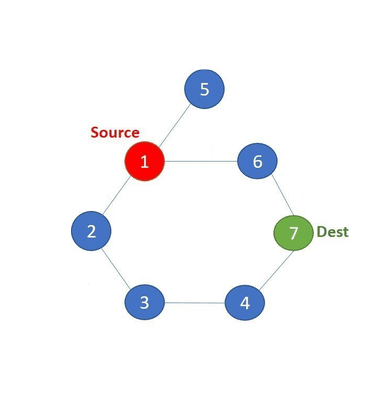
LeetCode: Graphs I BFS Shortest Path Unweighted Graph
Graphs Intro
LeetCode problems with graph based solutions.
What is a Graph?
A graph is a data structure used to represent relationships between entities.
1345. Jump Game IV ::1:: - Hard
Topics: BFS Shortest Path Unweighted Graph, Array, Hash Table, Breadth First Search, Rule Based Graph, Graph Theory
Intro
Given an array of integers arr, you are initially positioned at the first index of the array. In one step you can jump from index i to index: i + 1 where: i + 1 < arr.length. i - 1 where: i - 1 >= 0. j where: arr[i] == arr[j] and i != j. Return the minimum number of steps to reach the last index of the array. Notice that you can not jump outside of the array at any time.
| Example Input | Output |
|---|---|
| nums = [2,4,12], start = 2, goal = 12 | 2 |
| nums = [3,5,7], start = 0, goal = -4 | 2 |
| nums = [2,8,16], start = 0, goal = 1 | -1 |
Constraints:
1 ≤ nums.length ≤ 1000
-10^9 ≤ nums[i], goal ≤ 10^9
0 ≤ start ≤ 1000
start != goal
All the integers in nums are distinct.
Abstraction
integer
Pseudocode
Solution 1: [BFS] BFS Over Bounded Implicit Number Line Graph - Graph/BFS Implicit Grid
    def minimumOperations(self, nums: List[int], start: int, goal: int) -> int:

        # Note:
        # Fewest operations to reach a target value
        # using a Bounded Implicit Number-Line Graph

        # Values:
        # nums = [1, 2], start = 3, goal = 6

        # Legal Operations From x:
        # x + num, x - num, x ^ num, for every num in nums


        # BFS Over The Implicit "Current Value Of x" Graph

        # Each integer in [0, 1000] is a node in an implicit graph, with
        # no literal graph built up front. An edge connects value v to
        # v + num, v - num, and v ^ num for every num in nums, since
        # each is a single legal operation.

        # BFS explores values level by level:
        #   - the first time goal is reached
        #   - that level number is guaranteed to be the minimum number
        #     of operations.

        # BFS State Encoding:
        #   - each queued item tracks a single piece of info:
        #       - x => the current value reached so far

        # Legal Next Move:
        #   - From a state (x),
        #   - x + num, x - num, and x ^ num are all legal for every num in nums
        #   - but only results landing inside [0, 1000] can be used,
        #     since operations beyond that range are terminal
        #   - Values outside [0, 1000] are still valid endpoints if they equal goal,
        #     just not continuable.

        # Safety Insight:
        #   - Once a value has been visited, we know BFS has already
        #     reached it via the fewest possible operations, so we can
        #     safely skip requeuing it.

        # Edge Case:
        # already at the target with zero operations
        if start == goal:
            return 0

        # Iterative BFS Queue:
        # seed the queue with start, 0 operations taken so far
        queue = deque([start])

        # Self Edges and Parallel Edges Safety Tracking:
        #    - mark starting value as visited
        # sc: O(1001)
        visitedNum = {start}

        # BFS Depth Level
        #   - tracking min num of operations used to reach current depth level
        ops = 0

        while queue:

            ops += 1

            # Level By Level Expansion:
            #   - drain entire current level before incrementing ops
            #   - guarantees for every value discovered in this pass to
            #     have the same number of operations (depth) from start
            for _ in range(len(queue)):

                # Value previous jump:
                x = queue.popleft()

                # Explore Neighbors:
                # apply all 3 operations against every number in nums
                # tc: O(m), where m is len(nums)
                for num in nums:
                    for nextX in (x+num, x-num, x^num):

                        # Check:
                        # if goal reached, we are guaranteed to have
                        # the minimum number of operations, even if
                        # this endpoint falls outside [0, 1000]
                        if nextX == goal:
                            return ops

                        # Bounded Continuation:
                        # enque new state (nextX) if within [0, 1000]
                        # and not already visitedNum, since operations
                        # beyond that range are terminal
                        if 0 <= nextX <= 1000 and nextX not in visitedNum:
                            visitedNum.add(nextX)
                            queue.append(nextX)

        # All reachable in-range values processed without hitting
        # goal, no sequence of operations can reach it

        # overall: tc O(1001 * m), where m is len(nums), since each of
        #   the at most 1001 in-range values is expanded once, trying
        #   all 3 operations against every number in nums
        # overall: sc O(1001), for the visited set bounded by the fixed
        #   [0, 1000] range of continuable states
        return -1
752. Open the Lock ::1:: - Medium
Topics: BFS Shortest Path Unweighted Graph, Array, Hash Table, String, Breadth First Search, Rule Based Graph, Graph Theory
Intro
You have a lock in front of you with 4 circular wheels. Each wheel has 10 slots: '0', '1', '2', '3', '4', '5', '6', '7', '8', '9'. The wheels can rotate freely and wrap around: for example we can turn '9' to be '0', or '0' to be '9'. Each move consists of turning one wheel one slot. The lock initially starts at '0000', a string representing the state of the 4 wheels. You are given a list of deadends dead ends, meaning if the lock displays any of these codes, the wheels of the lock will stop turning and you will be unable to open it. Given a target representing the value of the wheels that will unlock the lock, return the minimum total number of turns required to open the lock, or -1 if it is impossible.
| Example Input | Output |
|---|---|
| deadends = ["0201","0101","0102","1212","2002"], target = "0202" | 6 |
| deadends = ["8888"], target = "0009" | 1 |
| deadends = ["8887","8889","8878","8898","8788","8988","7888","9888"], target = "8888" | -1 |
Constraints:
1 ≤ deadends.length ≤ 500
deadends[i].length == 4
target.length == 4
target will not be in the list deadends
target and deadends[i] consist of digits only
Abstraction
Find the minimum number of single-step moves from the starting state to the target state, while avoiding a set of forbidden states along the way.
Each lock combination is a node in an implicit graph and each single wheel turn is an edge to a neighboring combination, with invalid combinations being forbidden states.
BFS outward from the start state finds the shortest-path on an unweighted graph, while treating dead ends as boundaries for BFS.
Pseudocode
Sol 1: Shortest Path Unweighted Graph BFS
1. (dead = set(deadends))
2. if "0000" in dead:
    return -1
3. (queue = deque([("0000", 0)]))
4. (visited = set(["0000"]))
5. while queue:
   a. (state, moves) = queue.popleft()
   b. if state == target:
        return moves
   c. for i in range(4):
      digit = int(state[i])
      for change in (-1, 1):
         new_digit = (digit + change) % 10
         newState = state[:i] + str(new_digit) + state[i+1:]
         if newState not in visited and newState not in dead:
            visited.add(newState)
            queue.append((newState, moves + 1))
6. return -1
Solution 1: [BFS] Optimized BFS - Graph/BFS Lock Number Rotation Exploration
    def openLock(self, deadends: List[str], target: str) -> int:

        # BFS over the lock's state graph

        # Each 4-digit combination is represented as a node in an implicit graph,
        # meaning there is no literal grid/list to build,
        # but instead states are generated on the fly.
        # An edge connects two states if one wheel-turn transforms one into another,
        # as each of the 4 wheels can turn +1 or -1 with wraparound 0 <-> 9
        # BFS explores states level by level, so the first time a 'target' is dequeued,
        # it is guaranteed to be the shortest number of turns


        # Dead end states set
        # sc: O(n)
        dead = set(deadends)

        # Edge Case:
        # If starting position is a dead end, we cannot move.
        if "0000" in dead:
            return -1

        # Iterative BFS Queue:
        # set starting position as "0000" as begin exploring
        queue = deque([("0000", 0)])
        visited = set(["0000"])

        while queue:

            # Pop a state from the queue
            state, moves = queue.popleft()

            # Check:
            # if target reached, we are guaranteed to have minimum number of moves
            if state == target:
                return moves

            # Explore Neighbors:
            # turn all 4 wheels in +/- 1 directions
            for i in range(4):

                # pick 1 of the 4 wheels
                digit = int(state[i])

                # Two possible rotations:
                # +1 and -1 (with wraparound)
                for rotate in (-1, 1):

                    new_digit = (digit + rotate) % 10

                    # Grab original wheel digits,
                    # except for the one we just rotated
                    newState = (state[:i] + str(new_digit) + state[i+1:])

                    # Early Pruning:
                    # only queue state if:
                    # - not visited
                    # - not a dead end
                    if newState not in visited and newState not in dead:

                        visited.add(newState)
                        queue.append((newState, moves + 1))

        # Exhausted all possible rotation combinations without finding target

        # overall: tc O(10^4)
        # overall: sc O(10^4)
        return -1
433. Minimum Genetic Mutation ::1:: - Medium
Topics: BFS Shortest Path Unweighted Graph, Hash Table, String, Breadth First Search, Rule Based Graph, Graph Theory
Intro
A gene string can be represented by an 8-character long string, with choices from 'A', 'C', 'G', and 'T'. Suppose we need to investigate a mutation from a gene string startGene to a gene string endGene where one mutation is defined as one single character changed in the gene string. For example, "AACCGGTT" --> "AACCGGTA" is one mutation. There is also a gene bank bank that records all the valid gene mutations. A gene must be in bank to make it a valid gene string. Given the two gene strings startGene and endGene and the gene bank bank, return the minimum number of mutations needed to mutate from startGene to endGene. If there is no such a mutation, return -1. Note that the starting point is assumed to be valid, so it might not be included in the bank.
| Example Input | Output |
|---|---|
| startGene = "AACCGGTT", endGene = "AACCGGTA", bank = ["AACCGGTA"] | 1 |
| startGene = "AACCGGTT", endGene = "AAACGGTA", bank = ["AACCGGTA","AACCGCTA","AAACGGTA"] | 2 |
Constraints:
0 ≤ bank.length ≤ 10
startGene.length == endGene.length == bank[i].length == 8
startGene, endGene, and bank[i] consist of only the characters ['A', 'C', 'G', 'T'].
Abstraction
Find the minimum number of single-step moves from the starting state to the target state, while avoiding a set of forbidden states along the way.
Each genetic combination is a node in an implicit graph and each single gene swap is an edge to a neighboring combination, with combinations not in the bank being forbidden.
BFS outward from the start state finds the shortest-path on an unweighted graph, while treating dead ends as boundaries for BFS.
Pseudocode
Sol 1: Shortest Path Unweighted Graph BFS
1. (bankSet = set(bank))
2. if endGene not in bankSet:
    return -1
3. (gene_chars = ['A', 'C', 'G', 'T'])
4. (queue = deque([(startGene, 0)]))
5. visited = {startGene}
6. while queue:
   a. (geneString, mutations) = queue.popleft()
   b. if geneString == endGene: Return mutations
   c. for i in range(len(geneString)):
      for c in gene_chars:
         if c == geneString[i]: continue
            rotatedGene = geneString[:i] + c + geneString[i+1:]
         if rotatedGene in bankSet and rotatedGene not in visited:
            visited.add(rotatedGene)
            queue.append((rotatedGene, mutations + 1))
7. return -1
Solution 1: [BFS] Optimized BFS - Graph/BFS Lock Number Rotation Exploration
    def minMutation(self, startGene: str, endGene: str, bank: List[str]) -> int:

        # BFS over the gene mutation graph

        # Each gene string combination is represented as a node in an implicit graph,
        # meaning there is no literal grid/list to build,
        # but instead states are generated on the fly.
        # An edge connects two states if one gene slot modification transforms
        # one into another, as there are 4 possible gene letters.
        # BFS explores states level by level, so the first time a 'target' is dequeued,
        # it is guaranteed to be the shortest number of turns
        # as well as guaranteed to have all possible gene combinations


        # Turn valid gene list into set
        # sc: O(n)
        bankSet = set(bank)

        # Edge Case:
        # endGene is not reachable, no transformation sequence exists
        if endGene not in bankSet:
            return -1

        # All gene slot chars
        gene_chars = ['A', 'C', 'G', 'T']

        # Iterative BFS Queue
        queue = deque([(startGene, 0)])

        # Tracking
        # sc: O(n^4)
        visited = {startGene}

        while queue:


            geneString, mutations = queue.popleft()

            # Reached target gene:
            # Ensured we have taken the minimum number of steps to get to
            # the final combination, which implies we have all possible previous
            # combinations in the mutations list
            if geneString == endGene:
                return mutations

            # Modify each gene slot
            for i in range(len(geneString)):

                # Explore Neighbor:
                # Replace each gene slot with all other 3 genes
                for c in gene_chars:

                    # Skip original gene
                    if c == geneString[i]:
                        continue

                    # Grab all original gene slots,
                    # except for the slot we just modified
                    rotatedGene = geneString[:i] + c + geneString[i + 1:]

                    # Early Pruning:
                    # Only queue mutations that are valid (in bank) and unseen
                    if rotatedGene in bankSet and rotatedGene not in visited:
                        visited.add(rotatedGene)
                        queue.append((rotatedGene, mutations + 1))

        # Exhausted all reachable mutations without finding endGene

        # overall: tc O(n)
        # overall: sc O(n)
        return -1
127. Word Ladder ::1:: - Hard
Topics: BFS Shortest Path Unweighted Graph, Hash Table, String, Breadth First Search, Rule Based Graph, Graph Theory
Intro
A transformation sequence from word beginWord to word endWord using a dictionary wordList is a sequence of words beginWord -> s1 -> s2 -> ... -> sk such that: Every adjacent pair of words differs by a single letter. Every si for 1 ≤ i ≤ k is in wordList. Note that beginWord does not need to be in wordList sk == endWord Given two words, beginWord and endWord, and a dictionary wordList, return the number of words in the shortest transformation sequence from beginWord to endWord, or 0 if no such sequence exists.
| Example Input | Output |
|---|---|
| beginWord = "hit", endWord = "cog", wordList = ["hot","dot","dog","lot","log","cog"] | 5 |
| beginWord = "hit", endWord = "cog", wordList = ["hot","dot","dog","lot","log"] | 0 |
Constraints:
1 ≤ beginWord.length ≤ 10
endWord.length == beginWord.length
1 ≤ wordList.length ≤ 5000
wordList[i].length == beginWord.length
beginWord, endWord, and wordList[i] consist of lowercase English letters.
beginWord != endWord
All the words in wordList are unique.
Abstraction
Find the minimum number of single-step moves from the starting state to the target state, while avoiding a set of forbidden states along the way.
Each string is a node in an implicit graph and each single character swap is an edge to a neighboring string, with combinations not in the wordList being forbidden.
BFS outward from the start state finds the shortest-path on an unweighted graph, while treating dead ends as boundaries for BFS.
Pseudocode
Sol 1: Shortest Path Unweighted Graph BFS
1. (wordSet = set(wordList))
2. if endWord not in wordSet:
        return 0
3. (letters = 'abcdefghijklmnopqrstuvwxyz')
4. (queue = deque([(beginWord, 1)]))
5. (visited = set([beginWord]))
6. while queue:
   a. ((word, steps) = queue.popleft())
   b. if word == endWord:
       return steps
   c. for i in range(len(word)):
      for c in letters:
         if c == word[i]:
            continue
         newWord = word[:i] + c + word[i+1:]
         if newWord in wordSet and newWord not in visited:
            queue.append((newWord, steps+1))
            visited.add(newWord)
7. return -1
Solution 1: [BFS] BFS - Graph/something
    def ladderLength(self, beginWord: str, endWord: str, wordList: List[str]) -> int:

        # BFS over the word transformation graph

        # Each word is represented as a node in an implicit graph,
        # meaning there is no literal grid/list to build,
        # but instead states are generated on the fly.
        # An edge connects two words if they differ by exactly one letter
        # as each of the L letter slots can be swapper to any of the other 25 letters
        # BFS explores states level by level, so the first time 'endWord' is dequeued,
        # it is guaranteed to be reached via the shortest transformation sequence

        # Valid word list as a set
        # sc: O(V)
        wordSet = set(wordList)

        # Empty Check:
        # endWord is not reachable, no transformation sequence exists
        # tc: O(1)
        if endWord not in wordSet:
            return 0

        # All possible letters for each slot
        letters = 'abcdefghijklmnopqrstuvwxyz'

        # Iterative BFS Queue:
        # set starting position as beginWord, sequence steps starts at 1
        # (LeetCode counts the beginWord itself as the first word in the sequence)
        queue = deque([(beginWord, 1)])
        visited = set([beginWord])

        while queue:

            # Pop a transformation
            word, steps = queue.popleft()

            # Check:
            # if endWord reached, we are guaranteed to have the minimum sequence steps
            if word == endWord:
                return steps

            # Explore Neighbors:
            # swap every letter slot to every other possible letter
            # tc: O(L)
            for i in range(len(word)):

                # Grab original letter,
                # except for the one we're about to swap
                for c in letters:

                    # Skip original letter
                    if c == word[i]:
                        continue

                    # New transformation
                    newWord = word[:i] + c + word[i + 1:]

                    # Early Pruning:
                    # - not in wordSet, invalid word
                    # - already visited, we reached this via a shorter sequence
                    if newWord in wordSet and newWord not in visited:

                        # queue new valid transformation
                        queue.append((newWord, steps+1))
                        visited.add(newWord)

        # Exhausted all possible transformations without finding endWord

        # overall: tc O(n * L^2), where n = len(wordList), l = len(beginWord)
        #   for each word popped, we try l slots * 26 letters = O(l * 26),
        #   and each candidate word construction/hashing costs O(l)
        # overall: sc O(n * L), for the wordSet/visited set storing up to n words of steps l
        return -1
2608. Shortest Cycle in a Graph ::1:: - Hard
Topics: BFS Shortest Path Unweighted Graph, Breadth First Search, Rule Based Graph, Graph Theory
Intro
There is a bi-directional graph with n vertices, where each vertex is labeled from 0 to n - 1. The edges in the graph are represented by a given 2D integer array edges, where edges[i] = [ui, vi] denotes an edge between vertex ui and vertex vi. Every vertex pair is connected by at most one edge, and no vertex has an edge to itself. Return the length of the shortest cycle in the graph. If no cycle exists, return -1. A cycle is a path that starts and ends at the same node, and each edge in the path is used only once.
| Example Input | Output |
|---|---|
| n = 7, edges = [[0,1],[1,2],[2,0],[3,4],[4,5],[5,6],[6,3]] | 7 |
| n = 4, edges = [[0,1],[0,2]] | -1 |
Constraints:
2 ≤ n ≤ 1000
1 ≤ edges.length ≤ 1000
edges[i].length == 2
0 ≤ ui, vi < n
ui != vi
There are no repeated edges.
Abstraction
keys
Pseudocode
Solution 1: [BFS] BFS From Every Node With Parent Aware Cycle Detection - Graph/BFS Implicit Grid
    def findShortestCycle(self, n: int, edges: List[List[int]]) -> int:


        # Note:
        # Shortest cycle length in an undirected graph
        # using BFS Rooted At Every Node

        # Edge List:
        # edges = [[0,1],[1,2],[2,0],[1,3],[3,4],[4,1]]

        # Adjacency List:
        # adj = {
        #         0: [1, 2],
        #         1: [0, 2, 3, 4],
        #         2: [1, 0],
        #         3: [1, 4],
        #         4: [3, 1],
        #       }


        # BFS From Every Node To Detect The Shortest Cycle

        # Unlike a single-source shortest path, there's no fixed start
        # or target here, a cycle can pass through any node, so each
        # node in turn is treated as a BFS root. From a given root, BFS
        # assigns every reachable node a distance and a parent edge.

        # BFS explores nodes level by level:
        #   - whenever BFS reaches an already-visited node through an
        #     edge that isn't the one it arrived by
        #   - that means two distinct paths from the root converge
        #     there, and their combined length forms a cycle back
        #     through the root.

        # BFS State Encoding:
        #   - each queued item tracks a single piece of info:
        #       - node => the current node being expanded
        #   - dist[node]   => distance from root to node
        #   - parent[node] => the node used to first reach node

        # Legal Next Move:
        #   - From a state (node),
        #   - every adjacent edge is explored except the one leading
        #     back to parent[node],
        #   - since that edge was just used to arrive and isn't a
        #     cycle candidate back to itself.

        # Safety Insight:
        #   - Once a node has been visited from a given root, we know
        #     BFS has already recorded its shortest distance from that
        #     root, so a second arrival at it (via a non-parent edge)
        #     can only mean a cycle, never a shorter path.

        # Build Adjacency List:
        # build once and reused as the neighbor lookup for every root's
        # BFS, rather than rescanning edges each time
        # tc: O(V + E)
        adj = defaultdict(list)
        for u, v in edges:
            adj[u].append(v)
            adj[v].append(u)

        # Result Initialization:
        # infinity signals no cycle found yet, shrunk as shorter
        # cycles are discovered across every root tried
        shortest = float('inf')

        # Try Every Node As Root:
        # a cycle's shortest detection is only guaranteed if BFS is run
        # from a node actually on it, so every node must be tried
        # tc: O(V)
        for root in range(n):

            # Distance And Parent Tracking:
            # dist[-1] doubles as "unvisited"; parent tracks which node
            # was used to reach a node, so that same edge can be
            # excluded when checking for a cycle-closing edge
            # sc: O(V)
            dist = [-1] * n
            parent = [-1] * n
            dist[root] = 0

            # Iterative BFS Queue:
            # seed the queue with root, 0 edges used so far
            queue = deque([root])

            while queue:

                # Node previous jump:
                node = queue.popleft()

                # Explore Neighbors:
                # apply every edge out of the current node
                for neighbor in adj[node]:

                    # Skip Parent Edge:
                    # the edge just used to arrive at node should not be
                    # treated as a cycle candidate back to itself
                    if neighbor == parent[node]:
                        continue

                    # First Visit:
                    # unvisited neighbor extends the BFS tree normally
                    if dist[neighbor] == -1:
                        dist[neighbor] = dist[node] + 1
                        parent[neighbor] = node
                        queue.append(neighbor)

                    else:
                        # Cycle Detected:
                        # neighbor was already reached by a different
                        # path from root, so this edge closes a cycle
                        # whose length is both distances plus this edge
                        shortest = min(shortest, dist[node] + dist[neighbor] + 1)

        # All roots processed, shortest now holds the minimum cycle
        # length found across every BFS tree, or infinity if none exist

        # overall: tc O(V * (V + E)), since a full BFS is run once per
        #   vertex as root, each costing O(V + E)
        # overall: sc O(V + E), for the adjacency list plus the dist
        #   and parent arrays reused across each root's BFS
        return shortest if shortest != float('inf') else -1
1129. Shortest Path with Alternating Colors ::1:: - Medium
Topics: BFS Shortest Path Unweighted Graph, Breadth First Search, Rule Based Graph, Graph Theory
Intro
You are given an integer n, the number of nodes in a directed graph where the nodes are labeled from 0 to n - 1. Each edge is red or blue in this graph, and there could be self-edges and parallel edges. You are given two arrays redEdges and blueEdges where: redEdges[i] = [ai, bi] indicates that there is a directed red edge from node ai to node bi in the graph. blueEdges[j] = [uj, vj] indicates that there is a directed blue edge from node uj to node vj in the graph. Return an array answer of length n, where each answer[x] is the length of the shortest path from node 0 to node x such that the edge colors alternate along the path, or -1 if such a path does not exist.
| Example Input | Output |
|---|---|
| n = 3, redEdges = [[0,1],[1,2]], blueEdges = [] | [0,1,-1] |
| n = 3, redEdges = [[0,1]], blueEdges = [[2,1]] | [0,1,-1] |
Constraints:
1 ≤ n ≤ 100
0 ≤ redEdges.length, blueEdges.length ≤ 400
redEdges[i].length == blueEdges[j].length == 2
0 ≤ ai, bi, uj, vj < n
Abstraction
Find t
Pseudocode
Solution 1: [BFS] Optimized BFS - Graph/BFS Lock Number Rotation Exploration
    def shortestAlternatingPaths(self, n: int, redEdges: List[List[int]], blueEdges: List[List[int]]) -> List[int]:

        # Note:
        # Shortest path where edges must strictly alternate color
        # using two separate Edge Lists

        # Edge Lists:
        # redEdges  = [[0, 1], [1, 2]]
        # blueEdges = [[2, 0]]

        # Adjacency Lists By Color:
        # redAdj  = { 0: [1], 1: [2] }
        # blueAdj = { 2: [0] }


        # BFS Over The (Node, Last Edge Color) State Graph
        # - plain node to node BFS can't enforce alternation,
        #   since whether a given edge is legal to take next depends on the
        #   color of the edge used to arrive.
        # - So each state here is a pair (node, last color used),
        #   and an edge in this augmented graph only exists
        #   if its color differs from the color that led to the current state.

        # BFS explores states level by level:
        #   - the first time a node is reached via either color
        #   - that level number is guaranteed to be its shortest alternating path.

        # BFS State Encoding:
        #   - each queued item tracks two pieces of info:
        #       - node      => the current graph node
        #       - lastColor => the color of the edge used to arrive here
        #                      (0 = RED, 1 = BLUE)

        # Legal Next Move:
        #   - From a state (node, lastColor),
        #   - only edges of the opposite color are legal to take next,
        #   - since the path must strictly alternate colors on every step.

        # Self Edges and Parallel Edges Safety:
        #   - Once a (node, color) state has been visited, we know BFS has
        #     already reached it via the shortest possible path for that
        #     color, so we can safely skip requeuing it.

        # Build Adjacency Lists By Color:
        #   - separate red and blue edges up front,
        #     so the neighbor lookup during BFS only ever considers edges of the color needed
        # tc: O(E)
        redAdj = defaultdict(list)
        for u, v in redEdges:
            redAdj[u].append(v)

        blueAdj = defaultdict(list)
        for u, v in blueEdges:
            blueAdj[u].append(v)

        # Res:
        #   - (-1) signals unreached until BFS proves otherwise;
        #   - node 0 is always reachable from itself in 0 moves
        # sc: O(n)
        res = [-1] * n
        res[0] = 0

        # Color Constants:
        # 0 = RED, 1 = BLUE, used to track which color was last taken
        # into a node, since the same node can be reached via both
        # colors at potentially different distances
        RED, BLUE = 0, 1

        # Iterative BFS Queue:
        #   - seed both color states from node 0, since the very first move
        #     can legally be either color
        queue = deque([(0, RED), (0, BLUE)])

        # Self Edges and Parallel Edges Safety Tracking:
        #    - mark starting node as visited with both colors
        visited = {(0, RED), (0, BLUE)}

        # BFS Depth Level
        #   - tracking min num of steps to reach current nodes depth devel
        steps = 0

        while queue:

            steps += 1

            # Level By Level Expansion:
            #   - drain entire current level before incrementing steps
            #   - guarantees for every node discovered in this pass to have
            #     the same number of steps (depth) from node 0
            for _ in range(len(queue)):

                # Node previous jump:
                node, lastColor = queue.popleft()

                # Grab Possible Opposite Color Moves:
                #   - mark next jump
                if lastColor == RED:
                    nextColor = BLUE
                else:
                    nextColor = RED

                # Grab the correct adjacency list:
                #   - switch colors from dequed node previous jump
                if nextColor == BLUE:
                    nextAdj = blueAdj
                else:
                    nextAdj = redAdj

                # Explore Neighbors:
                #   - only the opposite color's edges are legal next, since
                #     the path must strictly alternate
                #   - we do not nee
                for neighbor in nextAdj[node]:

                    # Early Pruning:
                    #   - enque new state (node, color) if not already visited
                    if (neighbor, nextColor) not in visited:
                        visited.add((neighbor, nextColor))
                        queue.append((neighbor, nextColor))

                        # First Discovery Recording:
                        #   - whichever color state reaches a node first
                        #     gives its true shortest alternating distance,
                        #   - only record it the first time it's seen
                        if res[neighbor] == -1:
                            res[neighbor] = steps

        # All reachable (node, color) states processed, remaining -1s
        # mean no valid alternating path exists to that node

        # overall: tc O(n + E)
        # overall: sc O(n + E)
        return res
815. Bus Routes ::1:: - Hard
Topics: BFS Shortest Path Unweighted Graph, Array, Hash Table, Breadth First Search, Rule Based Graph, Graph Theory
Intro
You are given an array routes representing bus routes where routes[i] is a bus route that the ith bus repeats forever. For example, if routes[0] = [1, 5, 7], this means that the 0th bus travels in the sequence 1 -> 5 -> 7 -> 1 -> 5 -> 7 -> 1 -> ... forever. You will start at the bus stop source (You are not on any bus initially), and you want to go to the bus stop target. You can travel between bus stops by buses only. Return the least number of buses you must take to travel from source to target. Return -1 if it is not possible.
| Example Input | Output |
|---|---|
| routes = [[1,2,7],[3,6,7]], source = 1, target = 6 | 2 |
| routes = [[7,12],[4,5,15],[6],[15,19],[9,12,13]], source = 15, target = 12 | -1 |
Constraints:
1 ≤ routes.length ≤ 500
1 ≤ routes[i].length ≤ 10^5
All the values of routes[i] are unique.
sum(routes[i].length) ≤ 10^5
0 ≤ routes[i][j] < 10^6
0 ≤ source, target < 10^6
Abstraction
Buses
Pseudocode
Solution 1: [BFS] BFS Over Hyperedge Route Graph With Stop To Routes Map - Graph/BFS Implicit Grid
    def numBusesToDestination(self, routes: List[List[int]], source: int, target: int) -> int:

        # Note:
        # Fewest bus boardings to reach a target stop using a Stop To Routes Map

        # Hyperedge List:
        #   - each route is a hyperedge connecting a group of nodes,
        #     instead of just directly node to node

        #   - routes = [
        #               [1, 2, 7],
        #               [3, 6, 7]
        #              ]

        # Stop To Routes Map:
        #   - derived bridge structure, maps {stop -> routes servicing it}
        #   - this will reveal if routes share a stop,
        #     even if they do not belong to the same hyperedge

        # stopToRoutes = {
        #                  1: {0},
        #                  2: {0},
        #                  7: {0, 1},
        #                  3: {1},
        #                  6: {1},
        #                }

        # Implicit Route Graph:
        #   - the real graph BFS traverses, where each node is a route (getting on a bus)
        #     and two routes are adjacent if they share at least one stop

        # BFS Over The Bus Route Graph

        #   - rather than treating the stops as nodes,
        #     we treat the route themselves as nodes
        #   - two routes share are edge/are adjacent if they share at least one stop,
        #     since hopping on a bus to a shared stop allows you to transfer bus routes

        # BFS explores routes level by level:
        #   - the first time a route containing target stop is reached,
        #     those number of bus transfers is guaranteed to be the min num required

        # BFS State Encoding:
        #   - (routeIdx, busCount)
        #   - routeIdx => the current route (hyperedge) being ridden
        #   - busCount => the number of buses transfers to reach it

        # Legal Next Move:
        #   - From a state (routeIdx, busCount),
        #     only routes sharing a stop with routeIdx are legal to transfer to

        # Safety Insight:
        #   - Once a route has been visited,
        #     we know BFS has already reached it via the fewest possible boardings,
        #     so we can safely skip requeuing it.
        #   - Once a stop has been visited,
        #     every route servicing it has already been queued,
        #     so revisiting the stop can never surface a route worth expanding again.


        # ----------------------------
        # BFS Set up:

        # Edge Case:
        # already at the target without boarding any bus
        if source == target:
            return 0

        # Build Stop To Routes:
        #   - stop -> routes
        #   - allows for exploring what routes are available at a certain stop
        #   - checks what hyperedge a stop is connected to
        # tc: O(n)
        stopToRoutes = defaultdict(set)
        for routeIdx, route in enumerate(routes):
            for stop in route:
                stopToRoutes[stop].add(routeIdx)

        # Unreachable:
        #   - if stop has no routes assigned (new or in the middle of no where),
        #     then stop is unreachable
        # tc: O(1)
        if target not in stopToRoutes:
            return -1

        # Self Edges and Parallel Edges Safety Tracking:

        #   - avoid visiting a stop twice if we have found the shortest path already
        visitedStops = {source}

        #   - mark visiting a route twice if we have found the shortest path already
        # sc: O(s)
        visitedRoutes = set()

        # Iterative BFS Queue:
        #   - for the starting route, put all stops that serve it
        queue = deque()
        for routeIdx in stopToRoutes[source]:
            queue.append((routeIdx, 1))
            visitedRoutes.add(routeIdx)

        while queue:

            # Route previous jump:
            routeIdx, busCount = queue.popleft()

            # Target Check:
            #   - if this route services target,
            #     guaranteed to have the min num of bus transfers
            if target in routes[routeIdx]:
                return busCount

            # Explore Neighbors:
            #   - for each stop along this route,
            #     see what new routes are explorable by transferring at those stops
            for stop in routes[routeIdx]:

                # Visit Stop Once Pruning:
                #   - only add a new stop if not already visited
                #   - first time a stop is added, is guaranteed to be shortest transfers
                if stop not in visitedStops:

                    # mark stop as visited
                    visitedStops.add(stop)

                    # For each route at that stop
                    for nextRouteIdx in stopToRoutes[stop]:

                        # Visit Route Once Pruning:
                        #   - only add new route state if not already visited,
                        #   - first time a route is added, is guaranteed to be shortest transfers
                        if nextRouteIdx not in visitedRoutes:

                            # mark route as visited
                            visitedRoutes.add(nextRouteIdx)

                            # add exploration
                            queue.append((nextRouteIdx, busCount + 1))

        # All reachable routes processed without finding target,
        # no sequence of buses can reach it.

        # you are stranded

        # overall: tc O(n + s)
        # overall: sc O(n + s)
        return -1
4034. Minimum Bishop Moves to Reach Target ::2:: - Medium
Topics: BFS Shortest Path Unweighted Graph, Breadth First Search, Rule Based Graph, Graph Theory
Intro
There is an 8 x 8 empty chessboard with 1-indexed rows and columns. You are given an array source = [sr, sc] representing the starting position of a bishop, and an array target = [tr, tc]. In one move, the bishop travels any number of squares along a single diagonal direction, staying within the board. Return the minimum number of moves for the bishop to land exactly on target. If it can never reach target, return -1.
| Example Input | Output |
|---|---|
| x = 2, y = 1 | 1 |
| x = 5, y = 5 | 4 |
Constraints:
source.length == target.length == 2
1 ≤ sr, sc, tr, tc ≤ 8
source != target
Abstraction
Find the minimum number of single-move "slides" from the starting state to the target state on a finite grid, where each move can jump multiple cells at once along a diagonal.
Given a bishop at source, find the minimum number of moves to target.
BFS outward from the start state finds the shortest path on an unweighted graph, where each edge is an entire diagonal slide rather than a single-cell step. A same-color-square parity check up front lets us short-circuit the impossible case before searching at all.
Pseudocode
Sol 1: Shortest Path Unweighted Graph BFS
1. if source == target:
    a. return 0
2. (sourceSum = source[0] + source[1])
3. (targetSum = target[0] + target[1])
3. if sourceSum % 2 != targetSum % 2:
    a. return -1
4. directions = [(-1,-1), (-1,1), (1,-1), (1,1)]
5. queue = deque([(source[0], source[1], 0)])
6. visited = set([(source[0], source[1])])
7. while queue:
   a. (row, col, moves) = queue.popleft()
   b. for each (dr, dc) in directions:
      r, c = row + dr, col + dc
      while 1 <= r <= 8 and 1 <= c <= 8:
         if [r, c] == target: return moves + 1
         if (r, c) not in visited:
            visited.add((r, c))
            queue.append((r, c, moves + 1))
         r, c = r + dr, c + dc
8. return -1

Sol 2: Closed Form Diagonal Parity Classification
1. (sr, sc = source)
2. (tr, tc = target)
2. if source == target:
    a. return 0
3. if abs(sr - tr) == abs(sc - tc):
    a. return 1
4. if (sr + sc) % 2 != (tr + tc) % 2:
    a. return -1
5. return 2
Solution 1: [BFS] BFS With Diagonal Slide Edges - Graph/BFS Implicit Grid
    def minBishopMoves(self, source: list[int], target: list[int]) -> int:

        # BFS over the bishop's move graph

        # Each square on the 8x8 board is a node in an implicit graph.
        # Unlike the knight, a bishop's single move is an entire diagonal
        # slide: an edge connects source square (row, col) to every
        # square reachable by sliding in one of the 4 diagonal directions,
        # not just the adjacent cell. BFS still explores level by level,
        # so the first time target is reached, it is guaranteed to be
        # via the minimum number of moves.

        # Parity Pruning:
        # A bishop only ever visits squares of one color, determined by
        # the parity of (row + col). If source and target sit on
        # different colored squares, no sequence of moves can ever
        # connect them, so we can rule that out in O(1) before doing
        # any search at all.

        # Edge Case:
        # already at the target
        if source == target:
            return 0

        # different color squares, unreachable
        sourceSum = source[0] + source[1]
        targetSum = target[0] + target[1]
        if sourceSum % 2 != targetSum % 2:
            return -1

        # All 4 diagonal slide directions
        directions = [(-1, -1), (-1, 1), (1, -1), (1, 1)]

        # Iterative BFS Queue:
        # start at source, 0 moves taken
        queue = deque([(source[0], source[1], 0)])
        visited = {(source[0], source[1])}

        while queue:

            # Pop a position from the queue
            row, col, moves = queue.popleft()

            # Explore Neighbors:
            # apply all 4 diagonal directions, sliding as far as the
            # board allows in a single move
            for dr, dc in directions:

                # Try to step diagonally
                r, c = row + dr, col + dc

                # Check if diagonal step is in bounds:
                while 1 <= r <= 8 and 1 <= c <= 8:

                    # Diagonal step is valid, check if target

                    # Target Check:
                    #   - guaranteed to have min num of moves
                    if [r, c] == target:
                        return moves + 1

                    # Early Pruning:
                    #   - no revisiting squares
                    if (r, c) not in visited:
                        visited.add((r, c))
                        queue.append((r, c, moves + 1))

                    # Continue try to shift diagonally
                    r, c = r + dr, c + dc

        # shouldn't reach here for same-color squares on a bounded board

        # overall: tc O(1)
        # overall: sc O(1)
        return -1
Solution 2: [BFS] Closed-Form Diagonal Parity Classification - Graph/BFS Implicit Grid
    def minBishopMoves(self, source: list[int], target: list[int]) -> int:

        # Closed-form case analysis over bishop reachability

        # A bishop's moves are fully characterized by two properties:
        # which diagonal it's on (row - col, for one direction, and
        # row + col for the other), and which color square it occupies
        # (parity of row + col). Rather than exploring the graph level
        # by level, we can classify the relationship between source and
        # target directly into one of four fixed outcomes, since on an
        # 8x8 board a bishop can always reach any same-colored square
        # in at most 2 moves.

        sr, sc = source
        tr, tc = target

        # Edge Case:
        # already at the target
        if source == target:
            return 0

        # Same Diagonal Check:
        # if source and target lie on the same diagonal, abs(row delta)
        # equals abs(col delta), so a single slide connects them directly
        if abs(sr - tr) == abs(sc - tc):
            return 1

        # Parity Pruning:
        # a bishop only ever visits squares of one color, determined by
        # the parity of (row + col). If source and target sit on
        # different colored squares, no sequence of moves can ever
        # connect them
        if (sr + sc) % 2 != (tr + tc) % 2:
            return -1

        # Fallback Case:
        # same color, not on a shared diagonal, so the bishop is not one
        # slide away. On a bounded 8x8 board this is always reachable in
        # exactly 2 moves, since some intermediate square lies on a
        # diagonal shared with both source and target

        # overall: tc O(1), only a fixed number of comparisons regardless of input
        # overall: sc O(1), no auxiliary data structures used
        return 2
1197. Minimum Knight Moves ::2:: - Medium
Topics: BFS Shortest Path Unweighted Graph, Breadth First Search, Rule Based Graph, Graph Theory
Intro
You have a knight piece on an infinite chessboard, initially positioned at coordinate [0, 0]. The chessboard extends infinitely in all directions (from negative infinity to positive infinity). A knight in chess moves in an "L" shape, it can move exactly 2 squares in one cardinal direction (horizontal or vertical) and then 1 square perpendicular to that direction, or 1 square in a cardinal direction and then 2 squares perpendicular. This gives the knight 8 possible moves from any position: (-2, 1), (-1, 2), (1, 2), (2, 1), (2, -1), (1, -2), (-1, -2), (-2, -1) Given a target position [x, y], you need to find the minimum number of moves required for the knight to reach that position from its starting position [0, 0]. The problem guarantees that a solution always exists, the knight can always reach any position on the infinite board given enough moves.
| Example Input | Output |
|---|---|
| x = 2, y = 1 | 1 |
| x = 5, y = 5 | 4 |
Constraints:
-300 ≤ x, y ≤ 300
0 ≤ abs(x) + abs(y) ≤ 300
Abstraction
Find the minimum number of single-step moves from the starting state to the target state, while avoiding a set of forbidden states along the way.
Given a knight at (0, 0), find the minimum number of moves to the target coordinates.
BFS outward from the start state finds the shortest-path on an unweighted graph, while treating forbidden ends as boundaries for BFS.
Pseudocode
Sol 1: Shortest Path Unweighted Graph BFS
1. x, y = abs(x), abs(y)
2. if x == 0 and y == 0:
    return 0
3. moves = 8 knight move deltas
4. queue = deque([(0, 0, 0)])
5. visited = set([(0, 0)])
6. while queue:
   a. (cx, cy, moveCount) = queue.popleft()
   b. if cx == x and cy == y: Return moveCount
   c. for each (dx, dy) in moves:
      nx, ny = cx + dx, cy + dy
      if -2 <= nx <= x+2 and -2 <= ny <= y+2:
         if (nx, ny) not in visited:
            visited.add((nx, ny))
            queue.append((nx, ny, moveCount + 1))
7. return -1
Solution 1: [BFS] BFS With Quadrant Symmetry Pruning - Graph/BFS Implicit Grid
    def minKnightMoves(self, x: int, y: int) -> int:

        # BFS over the knight's move graph

        # Each square on the infinite chessboard is represented as a node
        # in an implicit graph, meaning there is no literal grid/list to
        # build, but instead squares are generated on the fly.
        # An edge connects two squares if a single knight move (one of
        # the 8 "L" shaped jumps) transforms one into the other.
        # BFS explores squares level by level, so the first time (x, y)
        # is dequeued, it is guaranteed to be reached via the minimum
        # number of moves.

        # Symmetry Pruning:
        # The knight's movement is symmetric across both axes, a move
        # that reaches (x, y) can be mirrored to reach (-x, y), (x, -y),
        # or (-x, -y) in the same number of moves. So we only ever need
        # to search within the first quadrant (x >= 0, y >= 0), and take
        # the absolute value of the target up front. This roughly
        # quarters the search space compared to searching the full plane.

        # Normalize target into the first quadrant
        x, y = abs(x), abs(y)

        # Edge Case:
        # already at the target
        if x == 0 and y == 0:
            return 0

        # All 8 possible knight moves
        moves = [(-2, 1), (-1, 2), (1, 2), (2, 1),
                 (2, -1), (1, -2), (-1, -2), (-2, -1)]

        # Iterative BFS Queue:
        # start at origin, 0 moves taken
        queue = deque([(0, 0, 0)])
        visited = set([(0, 0)])

        while queue:

            # Pop a position from the queue
            cx, cy, moveCount = queue.popleft()

            # Check:
            # if target reached, we are guaranteed to have the minimum number of moves
            if cx == x and cy == y:
                return moveCount

            # Explore Neighbors:
            # apply all 8 possible knight moves
            for dx, dy in moves:

                nx, ny = cx + dx, cy + dy

                # Pruning Bound:
                # clamp exploration to a small buffer past the first quadrant,
                # since occasionally dipping to -1 or -2 is needed to route
                # around the target efficiently, but going further negative
                # or far beyond the target never helps
                if -2 <= nx <= x + 2 and -2 <= ny <= y + 2:

                    # Early Pruning:
                    # only queue position if not already visited
                    if (nx, ny) not in visited:

                        visited.add((nx, ny))
                        queue.append((nx, ny, moveCount + 1))

        # overall: tc O(max(x, y)^2), bounded search space after symmetry
        #   and pruning keeps the frontier close to the target region
        # overall: sc O(max(x, y)^2), for the visited set storing explored squares
        return -1
1926. Nearest Exit from Entrance in Maze ::1:: - Medium
Topics: BFS Shortest Path Unweighted Graph, Array, Breadth First Search, Matrix, Grid, Graph Theory
Intro
You are given an m x n matrix maze (0-indexed) with empty cells (represented as '.') and walls (represented as '+'). You are also given the entrance of the maze, where entrance = [entrancerow, entrancecol] denotes the row and column of the cell you are initially standing at. In one step, you can move one cell up, down, left, or right. You cannot step into a cell with a wall, and you cannot step outside the maze. Your goal is to find the nearest exit from the entrance. An exit is defined as an empty cell that is at the border of the maze. The entrance does not count as an exit. Return the number of steps in the shortest path from the entrance to the nearest exit, or -1 if no such path exists.
| Example Input | Output |
|---|---|
| maze = [["+","+",".","+"],[".",".",".","+"],["+","+","+","."]], entrance = [1,2] | 1 |
| maze = [["+","+","+"],[".",".","."],["+","+","+"]], entrance = [1,0] | 2 |
| maze = [[".","+"]], entrance = [0,0] | -1 |
Constraints:
maze.length == m
maze[i].length == n
1 ≤ m, n ≤ 100
maze[i][j] is either '.' or '+'.
entrance.length == 2
0 ≤ entrance row < m
0 ≤ entrance col < n
entrance will always be an empty cell.
Abstraction
Find the minimum number of single-step moves from the starting state to the target state, while avoiding a set of forbidden states along the way.
Each cell is a node in an implicit graph and each single step up, down, left, right is an edge to a neighboring cell, with walls being forbidden states.
BFS outward from the start state finds the shortest-path on an unweighted graph, while treating forbidden ends as boundaries for BFS.
Pseudocode
Sol 1: Shortest Path Unweighted Graph BFS
1. (rows, cols = width, height)
3. (entranceRow, entranceCol) = entrance
4. (queue = deque([(entranceRow, entranceCol, 0)]))
5. (visited = set([(entranceRow, entranceCol)]))
6. while queue:
   a. (row, col, steps) = queue.popleft()
   b. if steps > 0 and cell is on border:
        return steps
   c. for neighbor (nr, nc)
      if neighbor (nr, nc) bounds:
         if maze[nr][nc] == '.' and (nr, nc) not in visited:
            visited.add((nr, nc))
            queue.append((nr, nc, steps + 1))
7. return -1
Solution 1: [BFS] BFS Grid Traversal - Graph/BFS Grid Traversal
    def nearestExit(self, maze: List[List[str]], entrance: List[int]) -> int:

        # BFS over the maze grid

        # Each cell is represented as a node in an implicit graph, the
        # grid itself acts as the adjacency structure, no separate
        # graph needs to be built.
        # An edge connects two cells if they're adjacent (up/down/left/right)
        # and the destination cell is empty ('.').
        # BFS explores cells level by level, so the first time a border
        # cell is dequeued, it is guaranteed to be reached via the
        # shortest number of steps.

        rows, cols = len(maze), len(maze[0])

        # 4 cardinal directions
        directions = [(-1, 0), (1, 0), (0, -1), (0, 1)]

        # Iterative BFS Queue:
        # start at entrance, 0 steps taken
        entranceRow, entranceCol = entrance
        queue = deque([(entranceRow, entranceCol, 0)])
        visited = set([(entranceRow, entranceCol)])

        while queue:

            # Pop a cell from the queue
            row, col, steps = queue.popleft()

            # Check:
            # if current cell is a border cell and not the entrance,
            # we are guaranteed to have the minimum number of steps
            # (entrance is excluded up front by only checking after the first pop)
            if steps > 0 and (row == 0 or row == rows - 1 or
                               col == 0 or col == cols - 1):
                return steps

            # Explore Neighbors:
            # move to all 4 adjacent cells
            for dr, dc in directions:

                nr, nc = row + dr, col + dc

                # Bounds Check:
                # stay within the grid
                if 0 <= nr < rows and 0 <= nc < cols:

                    # Early Pruning:
                    # only queue cell if:
                    # - not a wall
                    # - not already visited
                    if maze[nr][nc] == '.' and (nr, nc) not in visited:

                        visited.add((nr, nc))
                        queue.append((nr, nc, steps + 1))

        # Exhausted all reachable cells without finding a border exit

        # overall: tc O(m * n), each cell is visited and processed at most once
        # overall: sc O(m * n), for the visited set and queue storing up to every cell in the grid
        return -1
909. Snakes and Ladders ::1:: - Medium
Topics: BFS Shortest Path Unweighted Graph, Array, Breadth First Search, Matrix, Grid, Graph Theory
Intro
You are given an n x n integer matrix board where the cells are labeled from 1 to n^2 in a Boustrophedon style starting from the bottom left of the board (i.e. board[n - 1][0]) and alternating direction each row. You start on square 1 of the board. In each move, starting from square curr, do the following: Choose a destination square next with a label in the range [curr + 1, min(curr + 6, n2)]. This choice simulates the result of a standard 6-sided die roll: i.e., there are always at most 6 destinations, regardless of the size of the board. If next has a snake or ladder, you must move to the destination of that snake or ladder. Otherwise, you move to next. The game ends when you reach the square n2. A board square on row r and column c has a snake or ladder if board[r][c] != -1. The destination of that snake or ladder is board[r][c]. Squares 1 and n2 are not the starting points of any snake or ladder. Note that you only take a snake or ladder at most once per dice roll. If the destination to a snake or ladder is the start of another snake or ladder, you do not follow the subsequent snake or ladder. For example, suppose the board is [[-1,4],[-1,3]], and on the first move, your destination square is 2. You follow the ladder to square 3, but do not follow the subsequent ladder to 4. Return the least number of dice rolls required to reach the square n2. If it is not possible to reach the square, return -1.
| Example Input | Output |
|---|---|
| board look at LeetCode | 4 |
Constraints:
n == board.length == board[i].length
2 ≤ n ≤ 20
board[i][j] is either -1 or in the range [1, n^2]
The squares labeled 1 and n^2 are not the starting points of any snake or ladder.
Abstraction
Heh
Pseudocode
Solution 1: [BFS] BFS Grid Traversal - Graph/BFS Grid Traversal
    def snakesAndLadders(self, board: List[List[int]]) -> int:

        # Note:
        # Fewest dice rolls to reach the final square using an implicit square number graph

        # Board Labeling:
        # squares are numbered 1 to n^2 in a boustrophedon (zigzag)
        # pattern, starting bottom-left, alternating direction each row

        # Board Labeling (n = 4):
        #
        #   16   15   14   13
        #    9   10   11   12
        #    8    7    6    5
        #    1    2    3    4

        # Legal Moves From curr:
        #   - up to 6 steps, depending on die role,
        #     curr+1, curr+2, ..., curr+6
        #   - if a snake/ladder destination it hit then do that

        # BFS Over The Implicit Square Number Graph
        #   - Each square from 1 to n^2 is a node in an implicit graph
        #   - Edge connects curr every square in [curr+1, curr+6]

        # BFS explores squares level by level:
        #   - the first time the final square (n^2) is reached,
        #     its guaranteed to have the min num of dice rolls

        # BFS State Encoding:
        #   - curr square num

        # Legal Next Move:
        #   - From a state (curr), every square in [curr+1, curr+6] is legal,
        #     bounded by the boards final square
        #   - and any snake/ladder destination is immediately resolved landed on is immediately resolved to its
        #     to its destination before being treated as a state.

        # Revisiting:
        #   - Once a square (post snake/ladder resolution) has been visited,
        #     we know BFS has already reached it via the fewest possible rolls, so we can safely skip requeuing it.

        n = len(board)


        # Boustrophedon Flattening:
        #   - precompute a direct (cellNum -> (row, col) mapping once,
        #     so the zigzag row direction logic is resolved up front
        #     instead of being recomputed for every neighbor lookup during BFS

        # Boustrophedon Flattening (n = 4):
        #   - label layout (bottom-left start, zigzag):

        #   16   15   14   13
        #    9   10   11   12
        #    8    7    6    5
        #    1    2    3    4

        # Boustrophedon representation (n = 4):
        #   - board[row][col] indices (top-down, left-right):

        #                0     1     2     3
        # board[0] = [ (0,0) (0,1) (0,2) (0,3) ]   0
        # board[1] = [ (1,0) (1,1) (1,2) (1,3) ]   1
        # board[2] = [ (2,0) (2,1) (2,2) (2,3) ]   2
        # board[3] = [ (3,0) (3,1) (3,2) (3,3) ]   3

        # getCoords(6) => (2,2):
        #   row = (6-1)//4 = 1        <- boustrophedon row, counted from bottom, 0-indexed
        #   col = (6-1)%4  = 1        <- raw left-to-right offset within that row
        #   row % 2 == 1              -> odd row runs right-to-left, so flip: col = 4-1-1 = 2
        #   actualRow = 4-1-1 = 2     <- flip bottom-up row into top-down board row
        #   actualCol = 4-1-1 = 2     <- flip

        def cellNumToCoords(label):

            row = (label - 1) // n
            col = (label - 1) % n

            # Odd rows (counting from the bottom, 0-indexed) run
            # right-to-left, since the path alternates direction each row
            if row % 2 == 1:
                col = n - 1 - col

            # Board is indexed top-down, but labeling starts bottom-left
            actualRow = n - 1 - row

            return actualRow, col

        # Edge Case:
        # a 1x1 board starts and ends on the same square
        target = n * n
        if target == 1:
            return 0

        # Iterative BFS Queue:
        #   - init with square 1, with 0 rolls
        queue = deque([1])

        # Self Edges and Parallel Edges Safety Tracking:
        #    - mark starting square as visited
        # sc: O(n^2)
        visited = {1}

        # BFS Depth Level
        #   - tracking min num of dice rolls used to reach current depth level
        rolls = 0

        while queue:

            rolls += 1

            # Explore From Number Of Rolls:
            #   - from the current depth (dice rolls),
            #     explore the entire level before incrementing the rolls
            #   - guarantees for every square discovered in from this depth to next depth
            #     to have the same min number if rolls (depth)
            for _ in range(len(queue)):

                # Pick a square:
                curr = queue.popleft()

                # Explore Neighbors At The Number Of Rolls:
                #   - a single die roll can reach any square in the next 6,
                #     with a boundary at the last cell
                #   - need to do (+1) as the array is 1 indexed
                max6 = min(curr+6, target)
                for nextCellNum in range(curr+1, max6+1):

                    # Coords for next cell num
                    r, c = cellNumToCoords(nextCellNum)

                    # Snake/Ladder Resolution:
                    #   - if this square has a snake or ladder,
                    #     the move actually lands on its destination instead,
                    #     applied exactly once per roll rather than chaining further
                    dest = board[r][c] if board[r][c] != -1 else next_

                    # Check:
                    #   - if we've reached the final square, we are
                    #     guaranteed to have the minimum number of rolls
                    if dest == target:
                        return rolls

                    # Early Pruning:
                    #   - only enqueue cell if not already visited
                    if dest not in visited:
                        visited.add(dest)
                        queue.append(dest)

        # All reachable squares processed without hitting target,
        # no sequence of rolls can reach it

        # overall: tc O(n^2)
        # overall: sc O(n^2)
        return -1
864. Shortest Path to Get All Keys ::1:: - Hard
Topics: BFS Shortest Path Unweighted Graph, Array, Hash Table, Breadth First Search, Rule Based Graph, Graph Theory
Intro
You are given an m x n grid grid where: '.' is an empty cell. '#' is a wall. '@' is the starting point. Lowercase letters represent keys. Uppercase letters represent locks. You start at the starting point and one move consists of walking one space in one of the four cardinal directions. You cannot walk outside the grid, or walk into a wall. If you walk over a key, you can pick it up and you cannot walk over a lock unless you have its corresponding key. For some 1 ≤ k ≤ 6, there is exactly one lowercase and one uppercase letter of the first k letters of the English alphabet in the grid. This means that there is exactly one key for each lock, and one lock for each key; and also that the letters used to represent the keys and locks were chosen in the same order as the English alphabet. Return the lowest number of moves to acquire all keys. If it is impossible, return -1.
| Example Input | Output |
|---|---|
| grid = ["@.a..","###.#","b.A.B"] | 8 |
| grid = ["@..aA","..B#.","....b"] | 6 |
| grid = ["@Aa"] | -1 |
Constraints:
m == grid.length
n == grid[i].length
1 ≤ m, n ≤ 30
grid[i][j] is either an English letter, '.', '#', or '@'.
There is exactly one '@' in the grid.
The number of keys in the grid is in the range [1, 6].
Each key in the grid is unique.
Each key in the grid has a matching lock.
Abstraction
keys
Pseudocode
Solution 1: [BFS] BFS Over (Position, Keys Bitmask) State Graph - Graph/BFS Implicit Grid
    def shortestPathAllKeys(self, grid: List[str]) -> int:

        # Note:
        # Fewest moves to collect all keys on a grid
        # using a (Position, Keys Bitmask) State Graph

        # Grid:
        # grid = ["@.a.#", "###.#", "b.A.B"]

        # Keys And Locks:
        # lowercase = key, uppercase = matching lock, '@' = start
        # a lock is only passable once its matching key bit is set


        # BFS Over The (Position, Keys Collected) State Graph

        # A plain cell-to-cell BFS can't work here, since whether a
        # lock can be crossed depends on which keys have been picked
        # up so far, and the same cell can legitimately be revisited
        # with a different key set. So each state here is a triple
        # (row, col, keysBitmask), and an edge exists between states if
        # a single cardinal move is legal, either because the destination
        # is open floor, a key (which updates the bitmask), or a lock
        # whose corresponding bit is already set.

        # BFS explores states level by level:
        #   - the first time a state with all keys collected is reached
        #   - that level number is guaranteed to be the minimum number
        #     of moves.

        # BFS State Encoding:
        #   - each queued item tracks three pieces of info:
        #       - row, col => the current position on the grid
        #       - keys     => bitmask of keys collected so far

        # Legal Next Move:
        #   - From a state (row, col, keys),
        #   - a cardinal move onto floor or a key is always legal,
        #   - a cardinal move onto a lock is legal only if keys already
        #     has that lock's matching bit set.

        # Safety Insight:
        #   - Once a (position, keys) state has been visited, we know
        #     BFS has already reached it via the shortest possible
        #     path for that exact key set, so we can safely skip
        #     requeuing it.

        m, n = len(grid), len(grid[0])
        dirs = [(-1, 0), (1, 0), (0, -1), (0, 1)]

        # Locate Start And Count Keys:
        # scan once to find the starting cell and determine how many
        # total keys must be collected, since k is not given directly
        # tc: O(m * n)
        startRow, startCol = -1, -1
        totalKeys = 0
        for r in range(m):
            for c in range(n):
                cell = grid[r][c]
                if cell == '@':
                    startRow, startCol = r, c
                elif cell.islower():
                    totalKeys += 1

        # Target Bitmask:
        # all totalKeys bits set represents "every key collected"
        allKeysMask = (1 << totalKeys) - 1

        # Edge Case:
        # no keys exist on the board at all
        if totalKeys == 0:
            return 0

        # Iterative BFS Queue:
        # seed the queue with the start position and an empty key set
        start = (startRow, startCol, 0)
        queue = deque([start])

        # Self Edges and Parallel Edges Safety Tracking:
        #    - mark starting (position, keys) state as visited
        # sc: O(m * n * 2^k)
        visited = {start}

        # BFS Depth Level
        #   - tracking min num of moves used to reach current depth level
        moves = 0

        while queue:

            moves += 1

            # Level By Level Expansion:
            #   - drain entire current level before incrementing moves
            #   - guarantees for every state discovered in this pass to
            #     have the same number of moves (depth) from start
            for _ in range(len(queue)):

                # Position and keys previous jump:
                row, col, keys = queue.popleft()

                # Explore Neighbors:
                # apply all 4 cardinal moves from the current state
                for dr, dc in dirs:

                    nr, nc = row + dr, col + dc

                    # Bounds Check:
                    # skip moves that fall off the grid
                    if not (0 <= nr < m and 0 <= nc < n):
                        continue

                    cell = grid[nr][nc]

                    # Wall Pruning:
                    # walls are never passable regardless of keys held
                    if cell == '#':
                        continue

                    nextKeys = keys

                    # Lock Check:
                    # an uppercase cell is only passable if the matching
                    # key bit is already set in the current bitmask
                    if cell.isupper():
                        keyBit = 1 << (ord(cell) - ord('A'))
                        if not (keys & keyBit):
                            continue

                    # Key Pickup:
                    # a lowercase cell updates the bitmask with its bit,
                    # picked up automatically on stepping onto it
                    elif cell.islower():
                        nextKeys = keys | (1 << (ord(cell) - ord('a')))

                    # Check:
                    # if all keys have been collected, we are guaranteed
                    # to have the minimum number of moves
                    if nextKeys == allKeysMask:
                        return moves

                    # Early Pruning:
                    # enque new state (nr, nc, nextKeys) if not already
                    # visited, since revisiting can never yield a
                    # shorter path than the first time it was reached
                    nextState = (nr, nc, nextKeys)
                    if nextState not in visited:
                        visited.add(nextState)
                        queue.append(nextState)

        # All reachable (position, keys) states processed without
        # collecting every key, no path exists that gathers them all

        # overall: tc O(m * n * 2^k), since each of the m*n cells can be
        #   paired with up to 2^k distinct key bitmasks, and every state
        #   is expanded a constant number of times
        # overall: sc O(m * n * 2^k), for the visited set storing every
        #   explored (position, keys bitmask) state
        return -1