
LeetCode: Graphs II BFS Multi Source
Multi Source BFS Algorithm Intro
Intro
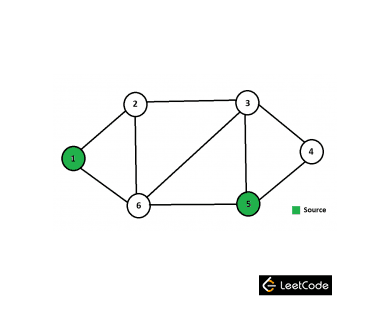
Multi Source BFS is an extension of Breadth First Search where we start BFS simultaneously from multiple source nodes.
It is commonly used to propagate distance or spread signals from multiple starting points and find shortest distances to all nodes or earliest reach times.
Unlike regular BFS single source, we enqueue all sources initially and expand layer by layer
Graph Requirements
- Unweighted or uniformly weighted graph (BFS gives shortest paths in unweighted graphs)
- Directed or Undirected
- Represented Using:
- Adjacency List
- Adjacency Matrix
Output
Shortest distance from the nearest source node to every other node
Can also track levels or earliest arrival times from any source
Useful for problems like 'spread of infection' or 'fire spread'
Video Animation
Multi Source BFS: ?
Pseudo Code
    def multi_source_bfs(graph, sources):

        visited = set(sources)
        distance = {node: 0 for node in sources}  # Distance from nearest source
        queue = deque(sources)

        while queue:
            node = queue.popleft()
            for neighbor in graph[node]:
                if neighbor not in visited:
                    visited.add(neighbor)
                    distance[neighbor] = distance[node] + 1
                    queue.append(neighbor)

        return distance
Time Complexity
Each node is visited at most once Each edge is processed at most once
O(V + E)
Space Complexity
Queue: O(V) Visited Set: O(V) Distance Map: O(V)
O(V)
IRL Use Case
-
Fire/Contamination Spread Simulation Track earliest time fire or infection reaches each point from multiple starting locations
-
Network Signal Propagation Spread from multiple routers in a network
994. Rotting Oranges ::2:: - Medium
Topics: Multi Source BFS, Array, Breadth First Search, Matrix
Intro
You are given an m x n grid where each cell can have one of three values: 0 representing an empty cell, 1 representing a fresh orange, or 2 representing a rotten orange. Every minute, any fresh orange that is 4-directionally adjacent to a rotten orange becomes rotten. Return the minimum number of minutes that must elapse until no cell has a fresh orange. If this is impossible, return -1.
| Example Input | Output |
|---|---|
| grid = [[2,1,1],[1,1,0],[0,1,1]] | 4 |
| grid = [[2,1,1],[0,1,1],[1,0,1]] | -1 |
| grid = [[0,2]] | 0 |
Constraints:
m == grid.length
n == grid[i].length
1 ≤ m, n ≤ 10
grid[i][j] is 0, 1, or 2.
Abstraction
Given a grid with oranges, return how much time until no fresh oranges remain.
Pseudocode
oh! pseudocode hasn't been written yet, try another card! :)Solution 1: [BFS] BFS Rotten Multi Source with Global Minutes Overwrite - Graph/something
    def orangesRotting(self, grid: List[List[int]]) -> int:

        # Multi Source BFS (Time Stored In Queue)
        # Determine minimum minutes required for all fresh oranges to rot

        # Idea:
        # - Start BFS from ALL rotten oranges simultaneously
        # - Each expansion spreads rot to neighbors
        # - Time (minutes) is carried inside queue state

        # BFS Property:
        # First time an orange is visited = earliest minute it rots

        # Edge Case + Setup

        # Empty Check: no time
        if not grid:
            return -1

        # boundaries
        # sc: O(1)
        m, n = len(grid), len(grid[0])

        # Count Fresh Oranges
        fresh = 0

        # Final Elapsed Time
        minutes = 0

        # Iterative Queue Holds: (row, col, minute)
        # sc: O(m*n)
        queue = deque()

        # Multi Source Setup:
        #   - get total count of fresh oranges
        #   - put all rotten oranges in BFS queue
        # tc: O(m*n)
        for r in range(m):
            for c in range(n):


                    # Pass next minute down BFS
                    queue.append((nr, nc, minutes + 1))

        # Final Validation:
        # if fresh oranges remain, they are unreachable
        res = minutes if fresh == 0 else -1

        # overall: tc O(m*n)
        # overall: sc O(m*n)
        return res
Solution 2: [BFS] BFS Rotten Multi Source with Level Processing Minutes Trigger - Graph/something
    def orangesRotting(self, grid: List[List[int]]) -> int:

        # Multi Source BFS (Time Stored In Queue)
        # Determine minimum minutes required for all fresh oranges to rot

        # Idea:
        # - Start BFS from ALL rotten oranges simultaneously
        # - Each expansion spreads rot to neighbors
        # - Time (minutes) is carried inside queue state

        # BFS Property:
        # First time an orange is visited = earliest minute it rots

        # Edge Case + Setup

        # Empty Check: no time
        if not grid:
            return -1

        # boundaries
        # sc: O(1)
        m, n = len(grid), len(grid[0])

        # Count Fresh Oranges
        fresh = 0

        # Final Elapsed Time
        minutes = 0

        # Iterative Queue Holds: (row, col, minute)
        # sc: O(m*n)
        queue = deque()

        # Multi Source Setup
        # Iterate across all cells
        # tc: O(m*n)
        for r in range(m):
            for c in range(n):

                # Append ALL rotten oranges as BFS roots
                if grid[r][c] == 2:
                    # add rotten orange as (row, col, minute)
                    queue.append((r, c, 0))

                # Add to fresh count
                elif grid[r][c] == 1:
                    fresh += 1

        # BFS Traversal:
        # Each poop represents earliest time this cell rots
        # tc: O(m*n) each cell processed once
        while queue and fresh > 0:

            # Process Multiple Roots:
            # All sources at this level
            for _ in range(len(queue)):

                # Process current root
                r, c = queue.popleft()

                # Process Choices:
                # 4 direction spread
                for dr, dc in [(1,0), (-1,0), (0,1), (0,-1)]:
                    nr, nc = r + dr, c + dc

                    # Early Pruning:
                    # Valid bounds and fresh fruit
                    if 0 <= nr < m and 0 <= nc < n and grid[nr][nc] == 1:

                        # Rot orange immediately
                        grid[nr][nc] = 2
                        fresh -= 1

                        # Add next rotten source to queue
                        queue.append((nr, nc))

            # Iterate global minutes tick for next source level
            minutes += 1

        # Final Validation:
        # if fresh oranges remain, they are unreachable
        res = minutes if fresh == 0 else -1

        # overall: tc O(m*n)
        # overall: sc O(m*n)
        return res
1298. Maximum Candies You Can Get From Boxes ::2:: - Hard
Topics: Multi Source BFS, Array, Breadth First Search, Matrix
Intro
You have n boxes labeled from 0 to n - 1. You are given four arrays: status, candies, keys, and containedBoxes where: status[i] is 1 if the ith box is open and 0 if the ith box is closed, candies[i] is the number of candies in the ith box, keys[i] is a list of the labels of the boxes you can open after opening the ith box. containedBoxes[i] is a list of the boxes you found inside the ith box. You are given an integer array initialBoxes that contains the labels of the boxes you initially have. You can take all the candies in any open box and you can use the keys in it to open new boxes and you also can use the boxes you find in it. Return the maximum number of candies you can get following the rules above.
| Example Input | Output |
|---|---|
| status = [1,0,1,0], candies = [7,5,4,100], keys = [[],[],[1],[]], containedBoxes = [[1,2],[3],[],[]], initialBoxes = [0] | 16 |
Constraints:
n == status.length == candies.length == keys.length == containedBoxes.length
1 ≤ n ≤ 1000
status[i] is either 0 or 1.
1 ≤ candies[i] ≤ 1000
0 ≤ keys[i].length ≤ n
0 ≤ keys[i][j] < n
All values of keys[i] are unique
0 ≤ containedBoxes[i].length ≤ n
0 ≤ containedBoxes[i][j] < n
All values of containedBoxes[i] are unique
Each box is contained in one box at most
0 ≤ initialBoxes.length ≤ n
0 ≤ initialBoxes[i] < n
Abstraction
Given a grid with oranges, return how much time until no fresh oranges remain.
Pseudocode
oh! pseudocode hasn't been written yet, try another card! :)Solution 1: [BFS] Multi Source BFS With Locked-Box Requeue - Graph/Multi Source BFS
    def maxCandies(self, status: List[int], candies: List[int], keys: List[List[int]], containedBoxes: List[List[int]], initialBoxes: List[int]) -> int:

        # Multi Source BFS (Locked Boxes Requeued Until Unlockable)

        # Multi Source:
        #   - treat every box, locked or unlocked as a source
        #   - only process the box once we have the key for it

        # Box Property:
        #   - a box is only ever opened once
        #   - a box may start in an unlocked status
        #   - a box in locked status, may not be opened until we have its matching key
        #   - a box, when opened, may contain candies, keys, and other boxes

        # Dequeue Locked Boxes w/o key:
        #   - if we deque a locked box that we don't have a key for,
        #     we requeue it to the back of the queue to wait if we find its key

        # Dequeue Locked Boxes w/ key:
        #   - may contain new candies, keys, and boxes
        #   - add keys and boxes to tracking hashmap
        #   - add candies to running candy count


        n = len(status)

        # Track Ownership/Access:
        #   - hasBox: we have the box, either from initialization or found within another box
        #   - hasKey: we have the key for this box, either from initialization or found within another box
        #   - opened: box has already been opened, we cannot reopen (double count)
        hasBox = [False] * n
        hasKey = [False] * n
        opened = [False] * n

        # Multi Source Setup:
        #   - every box is a source,
        #   - held until key is found
        # tc: O(len(initialBoxes))
        queue = deque()
        for b in initialBoxes:

            # box is waiting key
            hasBox[b] = True

            # append for waiting key check
            queue.append(b)

        # candies found
        totalCandies = 0

        # Stall Detection:
        #   - tracks consecutive requeues since the last successful open
        #   - resets to 0 on every open, since new keys/boxes released mean
        #     every currently-queued locked box deserves a fresh chance
        #   - if stalled reaches len(queue), a full lap produced zero opens,
        #     meaning nothing left in the queue can ever be opened
        stalled = 0

        # Continue While:
        #   - queue still has boxes to check
        #   - stalled hasn't caught up to the current queue size,
        #     len(queue) is a live threshold, updated every iteration,
        #     by removing opened boxes and requeuing locked boxes with now keys,
        #     and len(queue) can jump when a box opens and returns multiple new boxes
        # tc: O(n^2)
        while queue and stalled < len(queue):

            # Grab box to check
            box = queue.popleft()

            # Skip Already Opened:
            #   - boxes only opened once, avoid double counting
            #   - popleft() removed the opened box from the queue
            #   - on the next iteration, stalled will compare against the new queue len
            if opened[box]:
                continue

            # Openable Check:
            #   - if box was already unlocked (started unlocked), open
            #   - if box is locked but we have the key, open
            if status[box] == 1 or hasKey[box]:

                # Mark box as opened
                opened[box] = True

                # New box with new potential keys,
                # reset stalled count, and add back up
                stalled = 0

                # Add candies if box has any
                totalCandies += candies[box]

                # Add keys if box has any
                for k in keys[box]:
                    hasKey[k] = True

                # Add boxes if box has any
                for cb in containedBoxes[box]:
                    hasBox[cb] = True
                    queue.append(cb)

            # Not Openable:
            #   - box is locked, and we do not have the key
            #   - requeue box, add to stall count
            else:
                stalled += 1
                queue.append(box)

        # overall: tc O(n^2)
        # overall: sc O(n)
        return totalCandies
286. Walls and Gates ::2:: - Medium
Topics: Multi Source BFS, Hash Table, Depth First Search, Breadth First Search, Graph
Intro
You are given a (m) x (n 2D) grid initialized with these three possible values: -1 - A water cell that can not be traversed. 0 - A treasure chest. INF - A land cell that can be traversed. We use the integer 2^31 - 1 = 2147483647 to represent INF. Fill each land cell with the distance to its nearest treasure chest. If a land cell cannot reach a treasure chest then the value should remain INF. Assume the grid can only be traversed up, down, left, or right. Modify the grid in-place.
| Example Input | Output |
|---|---|
| look at diagram | look at diagram |
Constraints:
m == grid.length
n == grid[i].length
1 ≤ m, n ≤ 100
grid[i][j] is one of [-1, 0, 2147483647]
Abstraction
Given grid, fill each land grid with the distance to the nearest treasure.
Pseudocode
oh! pseudocode hasn't been written yet, try another card! :)Solution 1: [BFS] Multi Source BFS - Graph/something
    def islandsAndTreasure(self, grid: List[List[int]]) -> None:
        if not grid:
            return

        m, n = len(grid), len(grid[0])
        INF = 2147483647
        q = deque()

        # Step 1: Collect all treasure chests (multi-source roots)
        for r in range(m):
            for c in range(n):
                if grid[r][c] == 0:
                    q.append((r, c))

        # Step 2: BFS flood fill
        while q:
            r, c = q.popleft()

            for dr, dc in [(1,0), (-1,0), (0,1), (0,-1)]:
                nr, nc = r + dr, c + dc

                # Late Candidate Prune: out of bounds or not INF
                if not (0 <= nr < m and 0 <= nc < n):
                    continue
                if grid[nr][nc] != INF:
                    continue

                # Process Root: update distance from nearest treasure
                grid[nr][nc] = grid[r][c] + 1

                # Process Choices: explore neighbor
                q.append((nr, nc))

        # overall: time O(m * n), space O(m * n) (queue worst-case)
1765. Map of Highest Peak ::1:: - Medium
Topics: Multi Source BFS, Array, Breadth First Search, Matrix
Intro
You are given an integer matrix isWater of size m x n that represents a map of land and water cells. If isWater[i][j] == 0, cell (i, j) is a land cell. If isWater[i][j] == 1, cell (i, j) is a water cell. You must assign each cell a height in a way that follows these rules: The height of each cell must be non-negative. If the cell is a water cell, its height must be 0. Any two adjacent cells must have an absolute height difference of at most 1. A cell is adjacent to another cell if the former is directly north, east, south, or west of the latter (i.e., their sides are touching). Find an assignment of heights such that the maximum height in the matrix is maximized. Return an integer matrix height of size m x n where height[i][j] is cell (i, j)'s height. If there are multiple solutions, return any of them.
| Example Input | Output |
|---|---|
| isWater = [[0,1],[0,0]] | [[1,0],[2,1]] |
| isWater = [[0,0,1],[1,0,0],[0,0,0]] | [[1,1,0],[0,1,1],[1,2,2]] |
Constraints:
m == isWater.length
n == isWater[i].length
1 ≤ m, n ≤ 1000
isWater[i][j] is 0 or 1
There is at least one water cell
Abstraction
Simply find smallest distance between every single land piece to water cell. Its as simple as bfs.
Pseudocode
oh! pseudocode hasn't been written yet, try another card! :)Solution 1: [BFS] Multi Source BFS Pruning Optimization - Tree/DFS Post Order Recursive Two Sided Bottom Up
    def highestPeak(self, isWater: List[List[int]]) -> List[List[int]]:

        # Note:
        # Multi-source BFS: instead of starting from ONE source, seed the queue
        # with ALL water cells simultaneously (height 0), then expand outward together
        # 1. Process all water cells -> :
        #    height 0, added to queue as starting frontier
        # 2. Process -> neighbors :
        #    each unvisited neighbor is exactly 1 higher than the cell that reached it first
        # Result: BFS guarantees the FIRST time a cell is reached is via the
        #         SHORTEST path from its nearest water cell -> correct height

        # Dimensions
        m, n = len(isWater), len(isWater[0])

        # height: -1 sentinel means unvisited; water cells get 0, land gets filled in via BFS
        # sc: O(m*n)
        height = [[-1] * n for _ in range(m)]

        # queue: multi-source BFS frontier, seeded with ALL water cells at once
        queue = deque()

        # Seed queue:
        # every water cell starts as height 0, source of its own BFS wave
        for r in range(m):
            for c in range(n):
                if isWater[r][c] == 1:
                    height[r][c] = 0
                    queue.append((r, c))

        # directions: up, down, left, right (4-directional grid movement)
        directions = [(1, 0), (-1, 0), (0, 1), (0, -1)]

        # BFS: propagate heights outward level by level from all water cells
        while queue:
            r, c = queue.popleft()

            for dr, dc in directions:
                nr, nc = r + dr, c + dc

                # Early pruning:
                # skip out-of-bounds or already-visited cells
                # (already-visited means a closer water source already claimed it)
                if 0 <= nr < m and 0 <= nc < n and height[nr][nc] == -1:
                    height[nr][nc] = height[r][c] + 1
                    queue.append((nr, nc))

        # overall: tc O(m*n)
        # overall: sc O(m*n)
        return height
934. Shortest Bridge ::2:: - Medium
Topics: Multi Source BFS, Array, Depth First Search, Breadth First Search, Matrix
Intro
You are given an n x n binary matrix grid where 1 represents land and 0 represents water. An island is a 4-directionally connected group of 1's not connected to any other 1's. There are exactly two islands in grid. You may change 0's to 1's to connect the two islands to form one island. Return the smallest number of 0's you must flip to connect the two islands.
| Example Input | Output |
|---|---|
| grid = [[0,1],[1,0]] | 1 |
| grid = [[0,1,0],[0,0,0],[0,0,1]] | 2 |
| grid = [[1,1,1,1,1],[1,0,0,0,1],[1,0,1,0,1],[1,0,0,0,1],[1,1,1,1,1]] | 1 |
Constraints:
n == grid.length == grid[i].length
2 ≤ n ≤ 100
grid[i][j] is either 0 or 1
There are exactly two islands in grid
Abstraction
Given a list of undirected edges, determine if there are redundant connections.
Pseudocode
oh! pseudocode hasn't been written yet, try another card! :)Solution 1: [DFS + BFS] DFS Mark First Island + Multi Source BFS Expand To Second Island - Graph/something
    def shortestBridge(self, grid: List[List[int]]) -> int:

        # Idea:
        #    two islands exist in the grid, connected only through water (0s)
        #    step 1: DFS from any land cell finds and marks the entire first
        #    island (flip its cells to 2), seeding a queue with every cell
        #    of that island along the way
        #    step 2: multi-source BFS expands outward from the whole first
        #    island simultaneously, one water ring per level — the first
        #    time a cell adjacent to unflipped land (1) is reached, that
        #    ring count is the minimum number of water cells crossed

        n = len(grid)

        # directions: the 4 neighbor offsets to check per cell (up, down, left, right)
        directions = [(1, 0), (-1, 0), (0, 1), (0, -1)]

        def dfs(x, y, q):

            # Check:
            # mark this land cell as visited/part of the first island,
            # and seed it into the BFS queue as one of many starting points
            grid[x][y] = 2
            q.append((x, y))

            # Check:
            # explore all 4 neighbors, descending into any unvisited land
            for dx, dy in directions:
                nx, ny = x + dx, y + dy
                if 0 <= nx < n and 0 <= ny < n and grid[nx][ny] == 1:
                    dfs(nx, ny, q)

        # BFS Multi-Source Queue:
        # every cell belonging to the first island gets added here via DFS,
        # BEFORE the BFS loop below ever starts. This is what makes the next
        # phase multi-source: all of these cells enter the BFS already
        # sitting in the queue together, all treated as distance 0 at once —
        # not as separate single-source runs processed one at a time.
        queue = deque()

        # Check:
        # scan the grid for the first land cell found, DFS from there to
        # mark the entire first island — problem guarantees exactly two
        # islands, so any land cell belongs to one of them
        found = False
        for i in range(n):
            if found:
                break
            for j in range(n):
                if grid[i][j] == 1:
                    dfs(i, j, queue)
                    found = True
                    break

        # Check:
        # multi-source BFS: the queue already holds every cell of the first
        # island as simultaneous starting points. Each pass through the
        # `for _ in range(len(queue))` loop processes one entire frontier —
        # every cell currently in the queue, regardless of which original
        # island-1 cell it traces back to — before `steps` increments.
        # This guarantees the ring that first touches the second island is
        # the globally shortest distance from ANY point on the first island,
        # not just the distance from one arbitrarily chosen source.
        steps = 0
        while queue:
            for _ in range(len(queue)):
                x, y = queue.popleft()

                # Check:
                # examine all 4 neighbors of this cell
                for dx, dy in directions:
                    nx, ny = x + dx, y + dy
                    if 0 <= nx < n and 0 <= ny < n:

                        # Check:
                        # neighbor is unflipped land — this is the second
                        # island, shortest bridge found
                        if grid[nx][ny] == 1:
                            return steps

                        # Check:
                        # neighbor is unvisited water, mark visited and
                        # enqueue it to expand this shared frontier further
                        elif grid[nx][ny] == 0:
                            grid[nx][ny] = 2
                            queue.append((nx, ny))
            steps += 1

        # Check:
        # unreachable in practice — problem guarantees exactly two islands,
        # so the second island is always found during the BFS expansion

        # overall: tc O(n^2)
        # overall: sc O(n^2)
        return -1
417. Pacific Atlantic Water Flow ::2:: - Medium
Topics: Multi Source BFS, Array, Depth First Search, Breadth First Search, Matrix, Grid
Intro
There is an m x n rectangular island that borders both the Pacific Ocean and Atlantic Ocean. The Pacific Ocean touches the island's left and top edges, and the Atlantic Ocean touches the island's right and bottom edges. The island is partitioned into a grid of square cells. You are given an m x n integer matrix heights where heights[r][c] represents the height above sea level of the cell at coordinate (r, c). The island receives a lot of rain, and the rain water can flow to neighboring cells directly north, south, east, and west if the neighboring cell's height is less than or equal to the current cell's height. Water can flow from any cell adjacent to an ocean into the ocean. Return a 2D list of grid coordinates result where result[i] = [ri, ci] denotes that rain water can flow from cell (ri, ci) to both the Pacific and Atlantic oceans.
| Example Input | Output |
|---|---|
| grid height (see LeetCode) | res grid |
| grid height (see LeetCode) | res grid |
Constraints:
m == heights.length
n == heights[r].length
1 ≤ m, n ≤ 200
0 ≤ heights[r][c] ≤ 105
Abstraction
Given a grid of heights, return which cells can flow to the ocean.
Pseudocode
oh! pseudocode hasn't been written yet, try another card! :)Solution 1: [DFS] DFS Recursive Reverse Flow - Graph/something
    def pacificAtlantic(self, heights: List[List[int]]) -> List[List[int]]:

        # Note:
        # 1. Instead of simulating water flow downhill,
        #    we reverse the process and  start from the ocean cells
        #    and climb uphill to neighbors with height larger than the current cell,
        #    as when reversing ensures flow downhill.
        # 2. Each ocean will have its own visited set,
        #    which are cells that the ocean can reach while climbing upwards,
        #    or vice versa cells that can reach the ocean while flowing downwards.
        # 3. Cells that end up in both ocean sets can reach both oceans
        #    while flowing downhill


        # Empty check:
        if not heights:
            return []

        # Grid Traversal
        m, n = len(heights), len(heights[0])

        # seen
        pacific = set()
        atlantic = set()


        def dfs(r, c, oceanVisited, prev_height) -> None:

            # Check:
            # mark this cell as reachable from the ocean
            oceanVisited.add((r, c))

            # Check Neighbors:
            for nr, nc in ((r+1, c), (r-1, c), (r, c+1), (r, c-1)):

                # Valid Neighbor:
                #   - in bounds
                #   - not yet visited
                #   - height is taller or equal than current cell
                if (0 <= nr < m and 0 <= nc < n and
                        (nr, nc) not in ocean_visited and
                        heights[nr][nc] >= heights[r][c]):

                    # Explore Neighbor:
                    dfs(nr, nc, oceanVisited, heights[r][c])

        # Explore Pacific and Atlantic Edges:
        for i in range(m):
            # left column
            dfs(i, 0, pacific, heights[i][0])
            # right column
            dfs(i, n - 1, atlantic, heights[i][n - 1])
        for j in range(n):
            # top row
            dfs(0, j, pacific, heights[0][j])
            # bottom row
            dfs(m - 1, j, atlantic, heights[m - 1][j])

        # Cells reachable to both oceans
        # tc: O(V)
        intersection = list(pacific & atlantic)

        # overall: tc O(m*n)
        # overall: sc O(m*n)
        return intersection
Solution 2: [BFS] Multi Source BFS Reverse Flow Ocean Boarder Inwards - Graph/something
    def pacificAtlantic(self, heights: List[List[int]]) -> List[List[int]]:

        # Note:
        # 1. Same reverse flow idea, but BFS is used instead of DFS.
        # 2. BFS avoids recursion depth issues and may be easier to reason about.
        # 3. Initialize queues with Pacific and Atlantic edges separately.
        # 4. Traverse "uphill" from oceans, track visited cells for each.
        # 5. Answer = intersection of both visited sets.

        # Empty check
        if not heights:
            return []

        # Grid Iteration
        m, n = len(heights), len(heights[0])


        def bfs(starts: List[Tuple[int,int]]) -> set:

            # Visited set for BFS traversal
            oceanVisited = set(starts)

            # Iterative BFS queue
            queue = deque(starts)

            while queue:

                # Pop land cell
                r, c = queue.popleft()

                # Explore Neighbors:
                for dr, dc in [(1,0), (-1,0), (0,1), (0,-1)]:

                    # New land cell
                    nr, nc = r + dr, c + dc

                    # Early Prune:
                    #   - if cell is out of bounds or visited
                    #   - if cell is uphill
                    if (0 <= nr < m and 0 <= nc < n and
                        (nr, nc) not in oceanVisited and
                        heights[nr][nc] >= heights[r][c]):

                        # Mark as visited, which means reachable via just uphill
                        # from ocean -> land cell
                        oceanVisited.add((nr, nc))
                        queue.append((nr, nc))

            # Return all visited cells for this ocean
            # tc: O(n)
            # sc: O(n)
            return oceanVisited


        # Explore Pacific and Atlantic Edges:


        # Pacific:
        #   - Top row (first row)
        #   - Left column (first column)
        pacificOceanCells = []
        for j in range(n):
            pacificOceanCells.append((0, j))
        for i in range(m):
            pacificOceanCells.append((i, 0))

        # Atlantic:
        #   - Bottom row (last row)
        #   - Right column (last column)
        atlanticOceanCells = []
        for j in range(n):
            atlantic_starts.append((m - 1, j))
        for i in range(m):
            atlantic_starts.append((i, n - 1))

        # Reachable land cells for both pacific and atlantic
        pacific = bfs(pacificOceanCells)
        atlantic = bfs(atlantic_starts)

        # Cells reachable to both oceans
        # tc: O(V)
        intersection = list(pacific & atlantic)

        # overall: tc O(m*n)
        # overall: sc O(m*n)
        return intersection