
LeetCode: Arrays and Hashing
Arrays & Hashing Intro:
- What is a Hashmap
- Hashing With A Function
- Choosing a Hash Function
- Handling Collisions
- Balancing Hash Table With Load Factor
- Array Application: In place Transformations
- HashMap Application: Representations
- HashMap Application: Grouping by Criteria
- HashMap Application: Memoization in Dynamic Programming
- HashMap Application: Backtracking with Caching for Pruning
- HashMap Application: Representing Relationships
- HashMap Application: Index with Data Key
- HashMap Application: Algorithm
242. Valid Anagram ::4:: - Easy
- Intro
- Abstraction
- Pseudocode
- Solution 1: Hashmap Foreach Double Pass [TC Opt] - Hashmap/Representation
- Solution 2: Array of 26 Indexing Single Pass [SC Opt] - Hashmap/Representation
- Solution 3: [Follow up] Unicode Extension Normalization For Hashmap Foreach Double Pass - Hashmap/Representation
- Solution 4: [Follow up] Unicode Extension Normalization For Array of 26 Indexing Single Pass - Hashmap/Representation
128. Longest Consecutive Sequence ::3:: - Medium
- Intro
- Abstraction
- Pseudocode
- Solution 1: HashMap Bridging Left/Right Neighbor Continents And Updating Boundaries [TC Opt] - HashMap/Representation
- Solution 2: Unique Set Creating Rummy Run While Run Exists [TC Opt] - Hashmap/Representation
- Solution 3: Union Find Tree Grouping Elements By Run [TC Opt] - HashMap/Algorithm
912. Sort an Array ::2:: - Medium
- Intro
- Abstraction
- Pseudocode
- Solution 1: [Merge Sort] Divide and Conquer, Bottom-Up Merge - Sorting/Merge Sort
- Solution 2: [Heap Sort] Manual Max-Heap, In-Place Extraction - Sorting/Heap Sort
- Solution 3: [Quick Sort] Randomized Pivot, In-Place Partition - Sorting/Quick Sort
- Solution 4: [Counting Sort] Exploit Bounded Value Range - Sorting/Counting Sort
Arrays & Hashing Intro:
LeetCode problems with solutions using hashmaps.
What is a Hashmap
A dictionary is just a direct mapping of keys->values:
Dictionary: ['a': 2, 'b': 2, 'c' : 3, ...]
A Hashmap is just a dictionary that maps keys->values using a hash function. Hashmaps are a common use case for hashing. We choose hashing to maximize randomness and minimize collisions between elements to keys.
Hashing With A Function
Hashing is simply a function. It takes in an input and spits out an output. Here is the function mod, which takes in an integer and spits out an integer:
- 1 mod (3) = 1
- 2 mod (3) = 2
- 3 mod (3) = 0
- 4 mod (3) = 1
Now this is could be our function for our hashmap, but it would lead to high collisions and low randomness as there are only 3 possible key results: 0, 1, and 2. So hashmaps are only efficient as the chosen hash function.
Choosing a Hash Function
With a good hash function: Insert, Lookup, and Delete take O(1). In this case, every element gets its own unique key and so a lookup using this function would be constant O(1).
With a bad hash function: Insert, Lookup, and Delete take O(n). Lets say our function is hash():
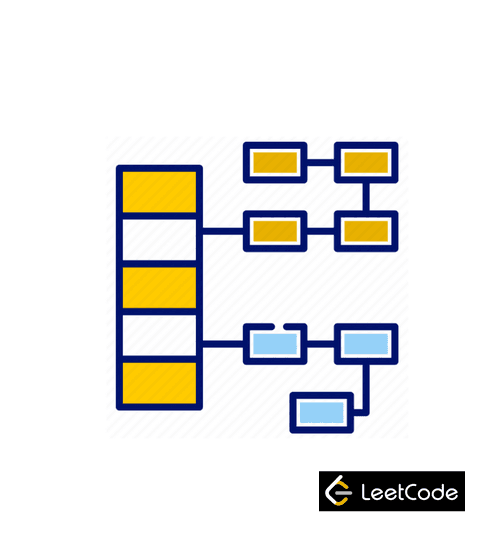
Handling Collisions
Even with a good hash function, we may run into collisions sometimes. In those cases, we handle collision using chaining with a linked list of elements.
Here, there are 5 keys or buckets we could hash to.
    hash()  ->  [key mod (5)]
    ----------------------------
    hash(10) = 10 % 5 = 0
    hash(22) = 22 % 5 = 2
    hash(31) = 31 % 5 = 1
    hash(14) = 14 % 5 = 4
hash(17) = 17 % 5 = 2 (collision!)| Key (index) | Value (element) |
|---|---|
| 0 | [10] |
| 1 | [31] |
| 2 | [22, 17] |
| 3 | [] |
| 4 | [14] |
Balancing Hash Table With Load Factor
Load factors are calculated to ensure a hash table maintains its O(1) time complexity.
Balancing occurs when a hash table has passed its set load factor.
Load Factor = n/m Where n = num of elements, m = num of keys
Thus, when certain fraction of the table size, say 75% full with 3 elements and 4 potential keys. The table must increase in size and rehash/reinsert every element.
The efficiency of a hash table decreases significantly without balancing, as this leads to increased collisions as the table fills up, which leads to time needed to resolve collisions, as we traverse through list to find the element in linear time O(n). Operations like search, insert, and delete, degrade from O(1) on average to O(n) in the worst case.
Usually, when the load factor is reached, the table size doubles to 2n. 0.75 or 75% full is a common load factor for a hash table.
Upon balancing, we need to rehash every element leading to n/2 additional space:
    New table size - current number of elements
    (double table size * load factor) - current n elements
    (2 n * 0.75)
    1.5 n  = New Load Factor Element Count

    New Load Factor Element Count - Current Element Count
    1.5 n - n
    0.5
    n/2 = Additional space until next rebalance
Rehashing is expensive as we need to rehash every element with the new hash function into their new bucket, leading to O(n) for resizing and reinserting n elements.
Array Application: In place Transformations
We can perform transformations or reorderings on the array itself without using extra space.
Ex: Rotate an array to the right by k steps.
    def rotate(nums: List[int], k: int) -> None:

        n = len(nums)
        k %= n  # handle cases where k > n

        # Opposite ends reverse subarray [start, end]
        def reverse(start: int, end: int) -> None:

            # Reverse until hit middle of subarray
            while start < end:
                nums[start], nums[end] = nums[end], nums[start]
                start += 1
                end -= 1

        # Reverse entire array
        reverse(0, n - 1)
        # Reverse first k elements [0, k)
        reverse(0, k - 1)
        # Reverse remaining elements [k, n)
        reverse(k, n - 1)
HashMap Application: Representations
We can represent objects or data based on specific criteria.
Ex: Representing a string by character frequency
    def freqCount():

        # object
        s = "aabbcc"

        # representation
        freq = {}

        # mapping
        for char in s:
            freq[char] = freq.get(char, 0) + 1

    # freq = {'a': 2, 'b': 2, 'c': 2}
HashMap Application: Grouping by Criteria
We can group elements based on a defined criterion, such as sorting or categorization, using hashing to push values into the corresponding bucket.
Ex: Grouping string anagrams
    def groupAnagrams(strs):

        # groups
        anagrams = {}

        # for list
        for word in strs:

            # create key
            key = "".join(sorted(word))
            if key not in anagrams:
                anagrams[key] = []

            # hash key and put value into bucket
            anagrams[key].append(word)

    # anagrams = {'aet': ['eat', 'tea', 'ate'], 'ant': ['tan', 'nat'], 'abt': ['bat']}
HashMap Application: Memoization in Dynamic Programming
We can store solutions to sub problems to avoid redundant calculations.
Ex: Fibonacci number computation with memoization
    def fib(n, memo={}):
        if n <= 1:
            return n
        if n not in memo:
            memo[n] = fib(n - 1, memo) + fib(n - 2, memo)
        return memo[n]
HashMap Application: Backtracking with Caching for Pruning
We can cache previous paths or states to prune the search space effectively as we explore.
Ex: Subset Sum with caching:
    def subsetSum(nums, target):

        result = []

        # Cache to avoid exploring previously visited paths
        cache = {}

        def dfs_backtrack(current, index, total):

            # Check if already explored state
            state = (tuple(current), total)
            if state in cache:
                return

            # Mark as explored
            cache[state] = True

            # Early Prune -> no potential valid path is current total exceeds target
            if total > target:
                return

            # Valid solution -> no need to explore further, backtrack
            if total == target:
                result.append(list(current))
                return

            # Explore -> branches from current state
            for i in range(index, len(nums)):

                # Build
                current.append(nums[i])
                # Explore
                dfs_backtrack(current, i + 1, total + nums[i])
                # Backtrack
                current.pop()

        dfs_backtrack([], 0, 0)
        return result
HashMap Application: Representing Relationships
We can model relationships between entities.
Ex: Adjacency list for a graph
    def graph():

        # List of edges in the graph
        edges = [(1, 2), (2, 3), (1, 3)]

        # Adjacency list
        graph = {}

        # Build the adjacency list
        for u, v in edges:

            # If the node 'u' or 'v' is not yet in the graph, initialize it
            if u not in graph:
                graph[u] = []
            if v not in graph:
                graph[v] = []

            # Add 'v' to the list of neighbors for 'u' and 'u' to 'v'
            graph[u].append(v)
            graph[v].append(u)

    # graph = {1: [2, 3], 2: [1, 3], 3: [2, 1]}
HashMap Application: Index with Data Key
We can index into arrays based on data or data structures.
Ex: Store integer complements for quick lookup:
    def twoSum(nums, target):

        # Complement -> index
        complement_map = {}

        for i, num in enumerate(nums):

            # Calculate complement
            complement = target - num

            # Lookup(complement)
            if num in complement_map:
                return [complement_map[num], i]

            # Put(complement)
            complement_map[complement] = i

        return []
HashMap Application: Algorithm
There are cases where problem that seems to require a hashmap have an existing algorithm made for that problem.
Ex: Boyer Moore Voting Algorithm
def majorityElement(nums: List[int]) -> int:

    # Find element that appears more then floor(n/2) times

    # votes for candidate
    count = 0

    # current candidate
    candidate = None

    for num in nums:

        # Reset candidate
        if count == 0:
            candidate = num

        if num == candidate:
            count += 1
        else:
            count -= 1

    # Confirm the candidate ( optional if majority element is guaranteed)
    return candidate
217. Contains Duplicate ::4:: - Easy
Topics: Array, Hash Table, Sorting
Intro
Given an integer array nums, return true if any value appears at least twice in the array, return false if every element is distinct.
| Example Input | Output |
|---|---|
| nums = [1,2,3,1] | true |
| nums = [1,2,3,4] | false |
| nums = [1,1,1,3,3,4,3,2,4,2] | true |
Constraints:
1 ≤ nums.length ≤ 105s
-109 ≤ nums[i] ≤ 109
Abstraction
Given a list of elements, check for duplicates.
Pseudocode
Sol 1: Hashmap Occurrence Counting To Detect Duplicate
1. (count = defaultdict(int))
2. for num in nums:
    a. if count[num] >= 1:
         return true
    b. count[num] += 1
3. return false

Sol 2: Seen Set TC Opt Membership Check To Detect Duplicate
1. (seen = set())
2. for n in nums:
    a. if n in seen:
         return true
    b. seen.add(n)
3. return false
Solution 1: Hashmap [TC Opt] - Hashmap/Representation
    def containsDuplicate(self, nums: List[int]) -> bool:

        # Note:
        # - track total count of nums during iteration
        # - if count is ever more than 1, duplicate exists

        # sc: O(n)
        count = defaultdict(int)

        # tc: O(n)
        for num in nums:

            # tc: O(1)
            if count[num] >= 1:
                return True

            # tc: O(1)
            count[num] += 1

        # overall: tc O(n)
        # overall: sc O(n)
        return False
Solution 2: Seen Set [TC Opt] - Hashmap/Representation
    def containsDuplicate(self, nums: List[int]) -> bool:

        # Note
        # - track nums we have seen during iteration
        # - if we encounter num we have already seen, duplicate exists

        # sc: O(n)
        seen = set()

        # tc: O(n)
        for n in nums:

            # tc: O(1)
            if n in seen:
                return True

            # tc: O(1)
            seen.add(n)

        # overall: tc O(n)
        # overall: sc O(n)
        return False
Solution 3: Unique Set Length Comparison - Hashmap/Representation
    def containsDuplicate(self, nums: List[int]) -> bool:

        # Note:
        # - set() in python remove duplicates, leaving only unique elements
        # - if the unique version of the original list is a different length, duplicates exist

        # Create unique set
        # tc: O(n)
        # sc: O(n)
        unique = set(nums)

        # Compare unique set length to original list length
        # tc: O(1)
        res = len(unique) != len(nums)

        # overall: tc O(n)
        # overall: sc O(n)
        return res
Solution 4: Sort Iterate Comparison [SC Opt] - Hashmap/Representation
    def containsDuplicate(self, nums: List[int]) -> bool:

        # tc: TimSort  = Python (2.3-3.10)
        # tc: PowerSort = Python (3.11+)
        #   - both have
        #   - worst: O(n log n)
        #   - avg: O(n log n)
        #   - best: O(n)

        # sc: both TimSort and PowerSort sort in place O(1)
        nums.sort()

        # tc: O(n)
        for i in range(1, len(nums)):

            # tc: O(1)
            if nums[i] == nums[i - 1]
                return True

        # overall: tc O(n log n) / O(n)
        # overall: sc O(1)
        return False
242. Valid Anagram ::4:: - Easy
Topics: Hash Table, String, Sorting
Intro
Given two strings s and t, return true if t is an anagram of s, and false otherwise. An Anagram is a word or phrase formed by rearranging the letters of a different word using all original letters exactly once.
| Example Input 'S' | Example Input 'T' | Output |
|---|---|---|
| "anagram" | "nagaram" | true |
| "rat" | "car" | false |
Constraints:
1 ≤ s.length, t.length ≤ 5 * 104
s and t consist of lowercase English letters
Abstraction
Given two strings determine if they have the same character count.
Pseudocode
oh! pseudocode hasn't been written yet, try another card! :)Solution 1: Hashmap Foreach Double Pass [TC Opt] - Hashmap/Representation
    def isAnagram(self, s: str, t: str) -> bool:

        # Char Count:
        # different amount of chars, cannot be anagram
        if len(s) != len(t):
            return False

        # sc: hashmap of 26 elements O(1)
        count = defaultdict(int)

        # tc: O(n * 2) ~ O(n)
        for x in s:
           count[x] += 1
        for x in t:
           count[x] -= 1

        # tc: O(1)
        for value in count.values():

            # If some char is not zero,
            # then there is a mismatch in that chars occurrence between the strings,
            # no anagram
            if value != 0:
                return False

        # overall: tc O(n)
        # overall: sc O(1)
        return True
Solution 2: Array of 26 Indexing Single Pass [SC Opt] - Hashmap/Representation
    def isAnagram(self, s: str, t: str) -> bool:

        # Note:
        # ord() converts unicode char to int representation
        # and use int to index into array

        # Char Count:
        # different amount of chars, cannot be anagram
        if len(s) != len(t):
            return False

        # sc: array of 26 constant O(1)
        count = [0] * 26

        # tc: O(n)
        for i in range(len(s)):
            count[ord(s[i]) - ord('a')] += 1
            count[ord(t[i]) - ord('a')] -= 1

        # tc: O(1)
        for value in count:
            if value != 0:
                return False

        # overall: tc O(n)
        # overall: sc O(1)
        return True
Solution 3: [Follow up] Unicode Extension Normalization For Hashmap Foreach Double Pass - Hashmap/Representation
    def isAnagram(self, s: str, t: str) -> bool:

        # Unicode:
        # - allows characters to be represented in multiple valid ways via composing system
        # - use base characters + marks to superimpose and create different alphabets
        # - allows for millions of characters and hundreds of diacritics (e.g., dots, tildes, strokes)
        # - this beats the alternative of having a millions of unique characters

        # Normalization:
        # - we need normalization to allow visually equivalent characters
        #   which have been created via different superimpositions to be equivalent

        # Real world examples:
        # - Text copied from different platforms or editors
        # - User input from different keyboards and OSes
        # - Databases storing mixed Unicode forms
        # - International and multilingual applications
        # - Prevent subtle equality bugs and security issues
        # - etc.

        # With normalization:
        # - these are visually equivalent, so they are equal
        #   "é" == "e\u0301"


        # NFC (Unicode Normalization Form C):
        # Combines characters into their superimposed forms to compare visually

        # So e +  ́ = é.
        # allows for even comparison

        # NFD = (Unicode Normalization Form Decomposition):
        # Takes a superimposed form and inverts it to its characters + marks

        # tc: O(n)
        # sc: O(n * 2) ~ O(n)
        import unicodedata
        s = unicodedata.normalize("NFC", s)
        t = unicodedata.normalize("NFC", t)

        # Char Count:
        # different amount of chars, cannot be anagram
        if len(s) != len(t):
            return False

        # sc: O(k)
        count = defaultdict(int)

        # tc: O(n)
        for c in s:
            count[c] += 1

        # tc: O(n)
        for c in t:
            count[c] -= 1

        # tc: O(k)
        for value in count.values():
            if value != 0:
                return False

        # overall: tc O(n)
        # overall: sc O(k)
        return True
Solution 4: [Follow up] Unicode Extension Normalization For Array of 26 Indexing Single Pass - Hashmap/Representation
    def isAnagram(self, s: str, t: str) -> bool:

        # Note: Unicode cannot be extended for fixed array of 26 solution

        # English lowercase letters are bounded: only 26
        # Unicode is not bounded:
        # > 140,000+ code points
        # multiple languages
        # emojis
        # symbols
        # combining characters

        # Thus, no fixed small upper bound we can use for our fixed array single pass solution
        # We need a hashmap / dictionary approach for variable size flexibility
49. Group Anagrams ::2:: - Medium
Topics: Array, Hash Table, String, Sorting
Intro
Given an array of strings strs, group the anagrams together. You can return the answer in any order. An Anagram is a word formed by rearranging the letters of a different word using all the original letters exactly once.
| Input | Output |
|---|---|
| ["eat","tea","tan","ate","nat","bat"] | [["bat"],["nat","tan"],["ate","eat","tea"]] |
| [""] | [[""]] |
| ["a"] | [["a"]] |
Constraints:
strs[i] consists of lowercase English letters
Abstraction
Group the matching anagrams together.
Pseudocode
oh! pseudocode hasn't been written yet, try another card! :)Solution 1: Array to Tuple Count Key [TC Opt] - Hashmap/Grouping by Criteria
    def groupAnagrams(self, strs: List[str]) -> List[List[str]]:

        # Note:
        # Tuples immutable, allowing them to be hashed
        # Array allows for constant ordered representation

        # sc: n words each of k chars O(n * k)
        anaGroup = {}

        # tc: O(n)
        for word in strs:

            # sc: O(1)
            charCount = [0] * 26

            # tc: O(n)
            for char in word:
                charCount[ord(char) - ord('a')] += 1

            # sc: array -> tuple O(1)
            key = tuple(charCount)

            # tc: O(1)
            if key not in anaGroup:
                anaGroup[key] = []

            # tc: O(1)
            anaGroup[key].append(word)


        # overall: tc O(n * k)
        # overall: sc O(n * k)
        return list(anaGroup.values())
Solution 2: Array to String Delimited Count Key [TC Opt] - Hashmap/Grouping by Criteria
    def groupAnagrams(self, strs: List[str]) -> List[List[str]]:

        # Note:
        # Appending to a list and joining once is more efficient than repeatedly
        # appending to a string. Strings are immutable, so each concatenation
        # creates a new string and copies all existing characters.
        # tc: list append + join: O(m), repeated string concat: O(m^2)

        # sc: stores n tuple keys O(n) and lists of original k strings O(k), O(n * k)
        anaGroup = {}

        # tc: iterate over list O(n)
        for word in strs:

            # sc: array of 26 constant O(1)
            charCount = [0] * 26

            # tc: iterate over string O(m)
            for char in word:
                charCount[ord(char) - ord('a')] += 1

            # tc: array of 26 to list O(1)
            values = []
            for count in charCount:
                values.append(str(count))
                # delimiter
                values.append("#")

            # tc: concat list of 26 to string O(1)
            groupCountKey = ''.join(values)

            # tc: in operation O(1)
            if groupCountKey not in anaGroup:
                anaGroup[groupCountKey] = []

            # tc: put operation O(1)
            anaGroup[groupCountKey].append(word)

        # overall: tc O(n * k)
        # overall: sc O(n * k)
        return list(anaGroup.values())
1. Two Sum I Not Sorted ::1:: - Easy
Topics: Array, Hash Table
Intro
Given an array of integers nums and an integer target, return indices of two numbers such that they add up to target. You can assume each test case only has one solution and you may cant use the same element twice. Answer can be returned in any order.
| nums[] | Target | Output |
|---|---|---|
| [2,7,11,15] | 9 | [0,1] |
| [3,2,4] | 6 | [1,2] |
| [3,3] | 6 | [0,1] |
Constraints:
Only one valid answer exists
2 ≤ nums.length ≤ 10^4
-10^9 ≤ target ≤ 10^9
Abstraction
We need to find two elements that add up to the target and return their indexes.
Pseudocode
oh! pseudocode hasn't been written yet, try another card! :)Solution 1: [Follow up] Hashmap Tracking Complement Target [TC Opt] - Hashmap/Index with Data Key
    def twoSum(self, nums: List[int], target: int) -> List[int]:

        # Note:
        # dictionary is complement -> index

        # sc: dictionary size relative to input O(n)
        tracking = {}

        # tc: iterate over list O(n)
        for i in range(len(nums)):

            # find the complement we should be tracking
            complement = target - nums[i]

            # tc: in operation O(1)
            if complement in tracking:
                return [i, tracking[complement]]

            # tc: put operation O(1)
            tracking[nums[i]] = i

        # overall: tc O(n)
        # overall: sc O(n)
        return []
2352. Equal Row and Column Pairs ::1:: - Medium
Topics: Array, Hash Table, Matrix, Simulation
Intro
Given a 0 indexed n x n integer matrix grid, return the number of pairs (ri, cj) such that row ri and column cj are equal. A row and column pair is considered equal if they contain the same elements in the same order (i.e., an equal array).
| Input | Output |
|---|---|
| [2,7,11,15] | 1 |
| grid = [[3,1,2,2],[1,4,4,5],[2,4,2,2],[2,4,2,2]] | 3 |
Constraints:
n == grid.length == grid[i].length
1 ≤ n ≤ 200
1 ≤ grid[i][j] ≤ 10^5
Abstraction
Find the number of rows that match columns
Pseudocode
oh! pseudocode hasn't been written yet, try another card! :)Solution 1: [Follow up] Hashmap Tracking Row Tuples And Matching Col Tuples - Hashmap/Index with Data Key
    def equalPairs(self, grid: List[List[int]]) -> int:

        # Note:
        # Hashing rows so we can compare columns directly,
        # instead of comparing each element in row/column pair directly (O(n^2) pairs * O(n) comparison = O(n^3)
        # Since rows and columns are just sequences of n integers, lists,
        # we can hash each row as a tuple (tuples are hashable, lists aren't)
        # and tally duplicates with a Counter.

        n = len(grid)

        # sc: O(n^2)
        rowCount = defaultdict(int)

        # Convert row, list, into tuple so it can be used as a dict key
        # tc: O(n)
        for row in grid:

            # Occur count for this sequence of values
            row = tuple(row)
            rowCount[row] += 1

        count = 0

        # Go across top of matrix to start each column
        # from 0-nth column
        # tc: O(n)
        for c in range(n):

            colList = []

            # Go down the column
            for r in range(n):
                colList.append(grid[r][c])

            # Find the occur count for this sequence of values
            col = tuple(colList)
            count += rowCount[col]

        # overall: tc O(n^2)
        # overall: sc O(n^2)
        return count
238. Product of Array Except Self ::2:: - Medium
Topics: Array, Prefix Sum
Intro
Given an integer array nums, return an array answer such that answer[i] is equal to the product of all the elements of nums except nums[i]. The product of any prefix or suffix of nums is guaranteed to fit in a 32-bit integer. You must write an algorithm that runs in O(n) time and without using the division operation.
| Input | Output |
|---|---|
| [1,2,3,4] | [24,12,8,6] |
| [-1,1,0,-3,3] | [0,0,9,0,0] |
Constraints:
Product of any prefix or suffix is guaranteed to fit into 32 bit integer
Abstraction
Given a list of nums, return a list of nums that is the product of the array excluding itself. For num n, the result should be the product of all the numbers to the left of it, times the product of all the numbers to the right of it.
Pseudocode
oh! pseudocode hasn't been written yet, try another card! :)Solution 1: Prefix, Postfix, Result Arrays - Array/In Place Transformations
    def productExceptSelf(self, nums: List[int]) -> List[int]:

        n = len(nums)

        # sc: prefix, postfix, result, arrays O(n)
        prefix = [1] * n
        postfix = [1] * n
        res = [1] * n

        # Prefix:
        # prefix of i = prefix of previous index * val of previous index
        # prefix[i] = prefix[i-1] * n[i-1]
        # tc: O(n)
        for i in range(1, n):
            prefix[i] = prefix[i-1] * nums[i-1]

        # Postfix:
        # postfix of i = postfix of next index * val of next index
        # postfix[i] = postfix[i+1] * n[i+1]
        # tc: O(n)
        for i in range(n-2, -1, -1):
            postfix[i] = postfix[i+1] * nums[i+1]

        # Result:
        # result[i] = prefix[i] * postfix[i]
        # tc: iterate list O(n)
        for i in range(n):
            res[i] = prefix[i] * postfix[i]

        # overall: tc O(n)
        # overall: sc O(n)
        return res
Solution 2: Result Array - Array/In Place Transformations
    def productExceptSelf(self, nums: List[int]) -> List[int]:

        n = len(nums)

        # sc: O(n)
        res = [1] * n

        # Prefix:
        # prefix[0] = 1
        # prefix[1] = prefix[0] * nums[0]
        # etc...
        # tc: O(n)
        for i in range(1, n):
            res[i] = res[i-1] * nums[i-1]

        # Postfix:
        # postfix[n-1] = 1
        # postfix[n-2] = postfix[n-1] * nums[n-1]
        # tc: O(n)
        postfix = 1
        for i in range(n-1, -1, -1):

            # res[i] = prefix[i] * postfix[i]
            # res[i] is already holding prefix[i] so we just need postfix
            res[i] *= postfix

            # postfix[i] = postfix[i] * nums[i]
            # postfix is already holding postfix[i] so we just need nums[i]
            postfix *= nums[i]

        # overall: tc O(n)
        # overall: sc O(1)
        return res
36. Valid Sudoku ::2:: - Medium
Topics: Array, Hash Table, Matrix
Intro
Determine if a 9 x 9 Sudoku board is valid. Only the filled cells need to be validated according to the following rules: Each row must contain the digits 1-9 without repetition. Each column must contain the digits 1-9 without repetition. Each of the nine 3 x 3 sub-boxes of the grid must contain the digits 1-9 without repetition.
Constraints:
Only the currently filled cells need to be validated, regardless is sudoku board is actually solvable or not.
| Input | Output |
|---|---|
| a sudoku table is too big to put here lol | just look at -> sudoku board example |
Abstraction
Abstract board into sets of rows, cols, and boxes, and validate whether duplicate values exist in any set.
Pseudocode
oh! pseudocode hasn't been written yet, try another card! :)Solution 1: DefaultDict With // Floor Division For (r,c) Immutable/Hashable Tuple Key - Hashmap/Representation
    def isValidSudoku(self, board: List[List[str]]) -> bool:

        # Dictionaries Immutable And Hashable Keys:
        # - keys can be any object that is both immutable and hashable
        # - allows us to create tuples for our keys

        # sc: O(9 * 9) ~ O(1)
        cols = defaultdict(set)
        rows = defaultdict(set)
        grids = defaultdict(set)

        # tc: O(9 * 9) ~ O(1)
        for r in range(9):
            for c in range(9):

                # Validate cell if its holding a num
                cell = board[r][c]
                if cell != ".":

                    # Break 9 x 9 grid into 3 x 3 box grids (9 total boxes)
                    # determine cell box location by = r/3, c/3
                    gridTuple = (r // 3, c // 3)

                    # tc: O(1)
                    if (cell in rows[r] or
                        cell in cols[c] or
                        cell in grids[gridTuple] ):
                        return False

                    # tc: O(1)
                    cols[c].add(cell)
                    rows[r].add(cell)
                    grids[gridTuple].add(cell)

        # overall: tc O(1)
        # overall: sc O(1)
        return True
Solution 2: Array of Arrays [[]] With // Floor Division For 9 Indexing Options [TC Opt] - Hashmap/Representation
    def isValidSudoku(self, board: List[List[str]]) -> bool:

        # Note:
        # Solution 2 is faster than Solution 1 for small sets,
        # such as our 9x9 board, due to defaultdict overhead.
        # defaultdict overhead benefits will only appear on large sets.
        # Array of arrays are most efficient for smaller sets.


        # sc: O(9 * 9) ~ O(1)
        rows = [[], [], [], [], [], [], [], [], []]
        col = [[], [], [], [], [], [], [], [], []]
        grids = [[], [], [], [], [], [], [], [], []]

        # tc: O(9 * 9) ~ O(1)
        for r in range(9):
            for c in range(9):

                # Validate cell if its holding a num
                cell = board[r][c]
                if cell != ".":

                    # indexing box sets by unique int calculation:
                    # ------------
                    #  (j//3)     = 0, 1, 2
                    #  (i//3) * 3 = 0, 3, 6
                    # ------------
                    #    0 1 2
                    # 0  0 1 2
                    # 3  3 4 5
                    # 6  6 7 8
                    # ------------
                    # allows to 9 indexing options

                    boxNum = (r//3) + ((c//3) * 3)

                    # tc: O(1)
                    if (cell in rows[r] or
                        cell in col[c]  or
                        cell in grids[boxNum]):
                        return False

                    # sc: O(1)
                    col[c].append(cell)
                    rows[r].append(cell)
                    grids[boxNum].append(cell)

        # overall: tc O(1)
        # overall: sc O(1)
        return True
128. Longest Consecutive Sequence ::3:: - Medium
Topics: Array, Hash Table, Union Find
Intro
Given an array of integers nums, return the length of the longest consecutive sequence of elements. A consecutive sequence is a sequence of elements in which each element is exactly 1 greater than the previous element You must wrtie an algorithm that runs in O(n) time.
| Input | Output |
|---|---|
| [100,4,200,1,3,2] | 4 from [1, 2, 3, 4] |
| [0,3,7,2,5,8,4,6,0,1] | 9 from [0, 1, 2, 3, 4, 5, 6, 7, 8] |
| [1, 0, 1, 2] | 3 from [0, 1, 2] |
Constraints:
0 ≤ nums.length ≤ 105
-109 ≤ nums[i] ≤ 109
Abstraction
Give a list of integers, find the longest sequence of increasing integers. This sequence does not have to follow the left to right order of the array.
Pseudocode
oh! pseudocode hasn't been written yet, try another card! :)Solution 1: HashMap Bridging Left/Right Neighbor Continents And Updating Boundaries [TC Opt] - HashMap/Representation
    def longestConsecutive(nums: List[int]) -> int:

        # Continent Boundaries:
        # Imagine a number line with runs of consecutive numbers being colored groups:

        #    0 1   4 5 6 7 8   11 12 13 14  19
        #    ***   #########   -----------  ++

        # Continent boundaries builds the lengths of these 'continents' as we iterate
        # - all continents start at 0
        # - if number has left and right number neighbors who have continent length
        # - 'bridge the continents' left and right lengths and add +1

        #     leftContinent_length   "+1 Bridge"   rightContinent_length

        longest = 0

        # sc: O(n)
        seqLen = defaultdict(int)

        # sc: O(n)
        numSet = set(nums)

        # tc: O(n)
        for num in numSet:

            # Get lengths of neighbor continents
            leftContinentLenFromBoundary = seqLen[num - 1]
            rightContinentLenFromBoundary = seqLen[num + 1]

            # calculate new connected bridge continent length
            bridgedLen = 1 + leftContinentLenFromBoundary + rightContinentLenFromBoundary

            # Update new continent boundaries
            seqLen[num - leftContinentLenFromBoundary] = bridgedLen
            seqLen[num + rightContinentLenFromBoundary] = bridgedLen

            # Compare to global max
            longest = max(longest, bridgedLen)

        # overall: tc O(n)
        # overall: sc O(n)
        return longest
Solution 2: Unique Set Creating Rummy Run While Run Exists [TC Opt] - Hashmap/Representation
def longestConsecutive(self, nums: List[int]) -> int:

    # Rummy Run:
    # Each number is part of only 1 sequence
    # and thus are only iterated over once.
    # Thus, the number of times the loop runs across
    # all iterations is O(n)

    longest = 0

    # sc: ignore duplicates O(n)
    numSet = set(nums)

    # tc: O(n)
    for runStartCandidate in numSet:

        # Found start of new run:
        # tc: O(1)
        if (runStartCandidate-1) not in numSet:

            # See how far this run goes
            # tc: O(n)
            currRunLen = 1
            while (runStartCandidate + currRunLen) in numSet:

                # Continue run check
                currRunLen += 1

            # Compare max
            longest = max(longest, currRunLen)

    # overall: tc O(n)
    # overall: sc O(n)
    return longest
Solution 3: Union Find Tree Grouping Elements By Run [TC Opt] - HashMap/Algorithm
    def longestConsecutive(self, nums: List[int]) -> int:

        # Union Find Tree:
        # Tracks sets of elements broken into non overlapping groups.
        # In this case it tracks elements broken into groups of corresponding runs.

        # Check Empty:
        # Avoid max(size.values()) return error
        if len(nums) == 0:
            return 0

        # Union Find Initialization:

        # Stores parent of each number
        # sc: O(n)
        parent = {}

        # Stores the size of connected components
        # sc: O(n)
        size = {}

        # Find + path compression
        # tc: O(α(n))
        def find(x):

            # Get Representative:
            # If the parent of x is not itself, keep going up
            if parent[x] != x:

                # Path compression:
                # Set parent of current, to the parent of its eventual parent,
                # the representative
                parent[x] = find(parent[x])

            # Representative Found:
            # Reached top of the group, either through compression or just regular parent, return representative
            return parent[x]

        # Union operation + size optimization
        # tc: O(α(n))
        def union(x, y):

            # Get parent for trees x and y
            rootX = find(x)
            rootY = find(y)

            # If trees do not share representative, they belong to different groups so join
            if rootX != rootY:

                # Grab tree sizes
                xSize = size[rootX]
                ySize = size[rootY]

                # Attach smaller tree to larger tree:
                # 1. join to larger tree and update size
                # 2. update smaller tree parent to larger tree representative
                if ySize < xSize:
                    parent[rootY] = rootX
                    size[rootX] += size[rootY]
                else:
                    parent[rootX] = rootY
                    size[rootY] += size[rootX]

        # Init Union Find:
        # tc: O(n)
        for num in nums:

            # Ignore duplicates
            if num not in parent:

                # 1. Set all parents to self
                # 2. Set all sizes to 1
                parent[num] = num
                size[num] = 1

        # Iterate and join elements into groups representing rummy runs
        # tc: O(n)
        for num in nums:

            # If the following number can join into a single run,
            # merge the groups
            if num + 1 in parent:
                union(num, num + 1)

        # Return group/tree (sequence of numbers) with longest size/length
        res = max(size.values())

        # overall: tc O(n)
        # overall: sc O(n)
        return res
912. Sort an Array ::2:: - Medium
Topics: Array, Divide and Conquer, Sorting, Heap (Priority Queue), Merge Sort, Bucket Sort, Radix Sort, Counting Sort
Intro
Given an array of integers nums, sort the array in ascending order and return it. You must solve the problem without using any built-in functions in O(n log n) time complexity and with the smallest space complexity possible.
| Example Input | Output |
|---|---|
| nums = [5,2,3,1] | [1,2,3,5] |
| nums = [5,1,1,2,0,0] | [0,0,1,1,2,5] |
Constraints:
1 ≤ nums.length ≤ 5 * 10^4
-5 * 10^4 ≤ nums[i] ≤ 5 * 10^4
Abstraction
Sort an array. A classic!
- Merge Sort
- Divide and conquer, stable
- tc: O(n log n)
- sc: O(n)
- Heap Sort
- In-place, manually built max-heap
- tc: O(n log n)
- sc: O(1)
- Randomized Quicksort
- In place, randomized pivot partitioning
- tc: O(n log n) expected / O(n²) worst case
- sc: O(log n)
- Counting Sort
- Not comparison-based, exploits bounded value range
- tc: O(n + range)
- sc: O(n + range)
Pseudocode
oh! pseudocode hasn't been written yet, try another card! :)Solution 1: [Merge Sort] Divide and Conquer, Bottom-Up Merge - Sorting/Merge Sort
    def sortArray(self, nums: List[int]) -> List[int]:

        # Merge Sort:
        # Classic divide and conquer -- split the array in half
        # recursively until each piece has 1 element (trivially sorted),
        # then merge pairs of sorted halves back together. The merge
        # step is what does the actual sorting work, in linear time
        # per level, across O(log n) levels.

        def mergeSort(arr: List[int]) -> List[int]:
            # Base case: a single element (or empty) is already sorted
            if len(arr) <= 1:
                return arr

            mid = len(arr) // 2

            # Recurse: sort each half independently
            left = mergeSort(arr[:mid])
            right = mergeSort(arr[mid:])

            # Merge the two sorted halves into one sorted array
            return merge(left, right)

        def merge(left: List[int], right: List[int]) -> List[int]:
            merged = []
            i = j = 0

            # Walk both halves simultaneously, always taking the
            # smaller front element -- this is what keeps the result
            # sorted and is also the classic "merge two sorted lists" op
            while i < len(left) and j < len(right):
                if left[i] <= right[j]:
                    merged.append(left[i])
                    i += 1
                else:
                    merged.append(right[j])
                    j += 1

            # Append any leftovers -- at most one of these loops runs
            merged.extend(left[i:])
            merged.extend(right[j:])

            return merged

        return mergeSort(nums)

        # overall: tc O(n log n), log n levels of recursion, O(n)
        #          merge work per level
        # overall: sc O(n), for the merged sub-arrays at each level
        #          (not in-place)
Solution 2: [Heap Sort] Manual Max-Heap, In-Place Extraction - Sorting/Heap Sort
    def sortArray(self, nums: List[int]) -> List[int]:

        # Heap Sort:
        # Build a max-heap out of the entire array IN-PLACE (no heapq,
        # since the problem disallows built-in sort/heap functions).
        # Then repeatedly swap the max (root) with the last unsorted
        # element and shrink the heap by one, restoring the heap
        # property each time. This sorts the array in-place with O(1)
        # extra space -- the best space complexity of these four solutions.

        n = len(nums)

        def siftDown(heapSize: int, root: int) -> None:
            # Sift Down:
            # push the element at `root` down until it's >= both its
            # children, restoring the max-heap property for the subtree
            largest = root
            left = 2 * root + 1
            right = 2 * root + 2

            if left < heapSize and nums[left] > nums[largest]:
                largest = left
            if right < heapSize and nums[right] > nums[largest]:
                largest = right

            # If a child was bigger, swap it up and keep sifting down
            # into whichever subtree we swapped into
            if largest != root:
                nums[root], nums[largest] = nums[largest], nums[root]
                siftDown(heapSize, largest)

        # Build-Heap:
        # start from the last non-leaf node and sift down each node --
        # this bottom-up build is O(n), not O(n log n), since most
        # nodes are near the bottom and sift down a short distance
        for i in range(n // 2 - 1, -1, -1):
            siftDown(n, i)

        # Extract:
        # the root of a max-heap is always the current largest element.
        # Swap it to the end (its final sorted position), shrink the
        # heap by one, then sift the new root down to restore the heap
        for end in range(n - 1, 0, -1):
            nums[0], nums[end] = nums[end], nums[0]
            siftDown(end, 0)

        return nums

        # overall: tc O(n log n) -- O(n) to build the heap,
        #          O(n log n) for n extractions each costing O(log n)
        # overall: sc O(1), sorts in-place (ignoring recursion stack,
        #          which can be made O(1) with an iterative siftDown)
Solution 3: [Quick Sort] Randomized Pivot, In-Place Partition - Sorting/Quick Sort
    def sortArray(self, nums: List[int]) -> List[int]:

        # To avoid Quick Sort O(n^2)
        # use pivot = nums[random.randint(left, right)],
        # instead of pivot = nums[(left + right) // 2]

        # Quick Sort (Randomized):
        # Pick a random pivot, partition the array in-place so
        # everything smaller ends up left of the pivot and everything
        # bigger ends up right, then recurse on each side. Randomizing
        # the pivot choice avoids the classic O(n^2) worst case that
        # a fixed pivot (like "always first element") hits on already
        # sorted or adversarial input.

        def quickSort(lo: int, hi: int) -> None:
            if lo >= hi:
                return

            pivotIndex = partition(lo, hi)

            # Recurse on both sides of the pivot's final position
            quickSort(lo, pivotIndex - 1)
            quickSort(pivotIndex + 1, hi)

        def partition(lo: int, hi: int) -> int:
            # Randomize:
            # swap a random element into the pivot slot (last position)
            # so the algorithm's performance doesn't depend on input order
            randIdx = random.randint(lo, hi)
            nums[randIdx], nums[hi] = nums[hi], nums[randIdx]

            pivot = nums[hi]
            i = lo  # boundary: everything before i is < pivot

            # Lomuto Partition:
            # walk through, and whenever we find something smaller
            # than the pivot, swap it into the "smaller" region and
            # advance the boundary
            for j in range(lo, hi):
                if nums[j] < pivot:
                    nums[i], nums[j] = nums[j], nums[i]
                    i += 1

            # Place the pivot in its correct final sorted position
            nums[i], nums[hi] = nums[hi], nums[i]

            return i

        quickSort(0, len(nums) - 1)
        return nums

        # overall: tc O(n log n) expected (randomization makes O(n^2)
        #          worst case astronomically unlikely in practice)
        # overall: sc O(log n) expected, for the recursion stack
        #          (in-place partitioning otherwise)
Solution 4: [Counting Sort] Exploit Bounded Value Range - Sorting/Counting Sort
    def sortArray(self, nums: List[int]) -> List[int]:

        # Counting Sort:
        # NOT comparison-based, so the usual O(n log n) lower bound
        # for comparison sorts doesn't apply here. Since constraints
        # guarantee values are bounded (-5*10^4 to 5*10^4, a range of
        # 10^5 + 1 possible values), we can count occurrences of each
        # value directly and reconstruct the sorted array from those
        # counts -- true O(n + range) time.

        # Why this isn't "cheating" the O(n log n) requirement:
        # the problem asks for a solution "in O(n log n) time" as a
        # baseline expectation (ruling out naive O(n^2) approaches),
        # and counting sort satisfies that trivially since
        # O(n + range) is asymptotically better when range is bounded --
        # but it's only viable BECAUSE the constraints guarantee a
        # bounded range; it wouldn't work for arbitrary integers.

        OFFSET = 50000  # shift negative values into a valid index range
        RANGE = 100001  # -50000 to 50000 inclusive

        # sc: O(range), one counter per possible value
        counts = [0] * RANGE

        # Count occurrences of each value
        # tc: O(n)
        for num in nums:
            counts[num + OFFSET] += 1

        result = []

        # Reconstruct:
        # walk counts in ascending order, appending each value as
        # many times as it occurred
        # tc: O(n + range), range dominates only when range >> n
        for i, count in enumerate(counts):
            if count > 0:
                result.extend([i - OFFSET] * count)

        # overall: tc O(10^5) ~ O(n + range)
        # overall: sc O(n + range)
        return result