
Hackerrank: Matrix
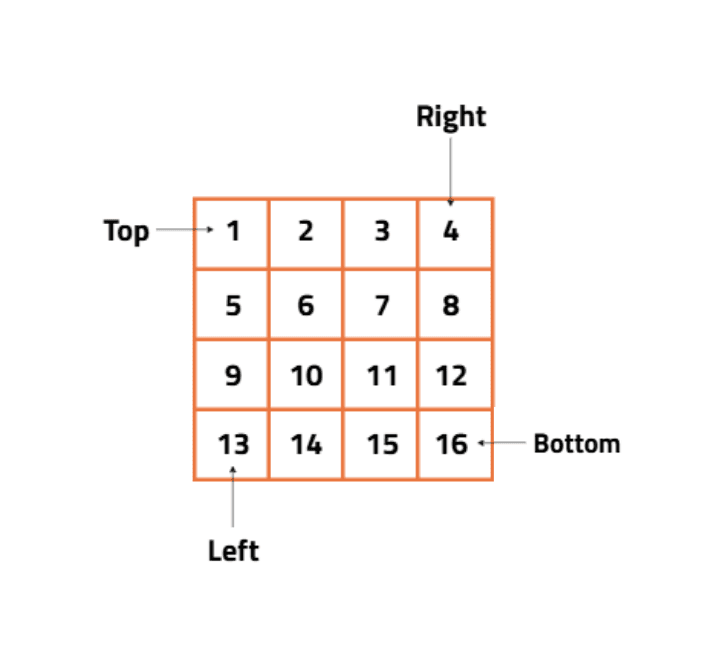
Matrix intro
Hackerrank problems involving matrixes.
What is a Matrix
Its a grid!
Its got a top, right, bottom, left! What more do you want!??!?! Its a matrix!
-1. Hourglass Sum ::1:: - Easy
Topics: Array, Matrix, Simulation
Intro
Given a 6x6 2D integer array arr, an hourglass is a subset of values with indices falling in this pattern:
a b c
  d
e f g
There are 16 hourglasses in a 6x6 array. The hourglass sum is the sum of the values in an hourglass. Calculate the hourglass sum for every hourglass in arr, then return the maximum hourglass sum.
| Example Input | Output |
|---|---|
| arr = [[1,1,1,0,0,0],[0,1,0,0,0,0],[1,1,1,0,0,0],[0,0,2,4,4,0],[0,0,0,2,0,0],[0,0,1,2,4,0]] | 19 |
| arr = [[-9,-9,-9,1,1,1],[0,-9,0,4,3,2],[-9,-9,-9,1,2,3],[0,0,8,6,6,0],[0,0,0,-2,0,0],[0,0,1,2,4,0]] | 28 |
Constraints:
arr.length == 6
arr[i].length == 6
-9 ≤ arr[i][j] ≤ 9
Abstraction
Given a fixed 6x6 matrix, slide a 3x3 hourglass-shaped stencil (top row, middle center cell, bottom row) across every valid top-left starting position (rows 0-3, cols 0-3), sum the 7 cells covered by the stencil at each position, and return the largest sum found.
Pseudocode
oh! pseudocode hasn't been written yet, try another card! :)Solution 1: Fixed-Window Stencil Scan Over 4x4 Valid Positions - Basic DSA/Matrix
    def hourglassSum(self, arr: List[List[int]]) -> int:

        # An hourglass covers a 3x3 footprint but only 7 of the 9 cells:
        # a b c
        #   d
        # e f g
        # (the two side-middle cells, matrix[r+1][c] and matrix[r+1][c+2], are excluded)

        # Fixed 6x6 grid:
        # Since the grid is always 6 rows by 6 cols, the top-left corner
        # of an hourglass can only start at rows 0-3 and cols 0-3
        # (any further and the hourglass would run off the grid).
        # This gives exactly 4 * 4 = 16 possible hourglasses, matching the problem statement.

        # Hourglass Ex:
        # [ 2  4  4]
        # [   2   ]   ==> sum = 2+4+4 + 2 + 1+2+4 = 19
        # [ 1  2  4]

        # Note:
        # 1. Iterate every valid top-left position (row, col) in range 0-3
        # 2. At each position, sum the 3 top cells, the 1 middle cell,
        #    and the 3 bottom cells
        # 3. Track the running maximum across all 16 hourglasses

        # Track the best sum seen so far.
        # Start at -inf since all values could be negative
        # (constraints allow -9 to 9), so 0 is not a safe default.
        max_sum = float('-inf')

        # Valid starting corners:
        # row+2 and col+2 never exceed index 5 (last valid index)
        # since row, col only range 0-3
        # tc: O(1) — fixed 16 iterations regardless of input (grid size is constant)

        for row in range(4):
            for col in range(4):
                top    = arr[row][col] + arr[row][col+1] + arr[row][col+2]
                middle = arr[row+1][col+1]
                bottom = arr[row+2][col] + arr[row+2][col+1] + arr[row+2][col+2]

                current_sum = top + middle + bottom
                max_sum = max(max_sum, current_sum)


        # overall: tc O(1) (constant 6x6 input) / O(n^2) if generalized to n x n grid
        # overall: sc O(1) — no extra structures beyond a running max
        return max_sum